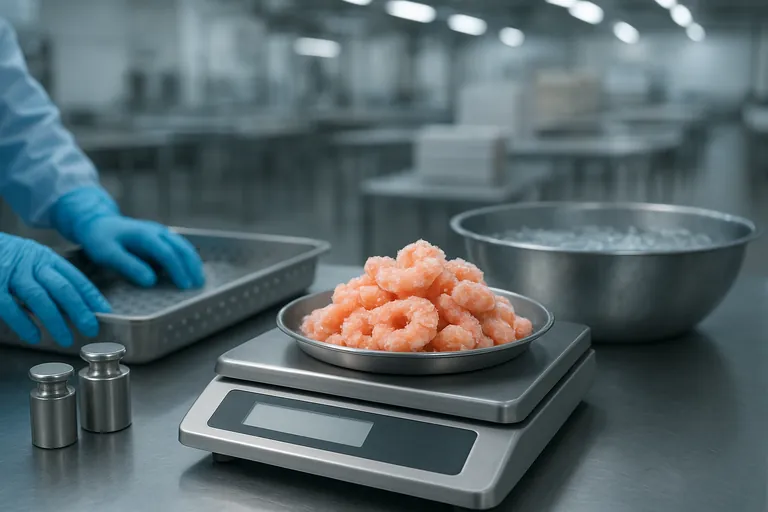
A practical, field-tested blueprint for FSMA 204 seafood labeling. Exact data to print on master cartons and inner packs, how to assign Traceability Lot Codes, GS1-128 vs QR, pallet SSCC, printers that survive wet freezers, and a one-page label spec buyers can approve.
If you sell Indonesian seafood to the U.S., 2026 will be the year your packaging gets judged at the dock. We took one mixed-fish plant from scattered paper records to buyer-approved, FSMA 204 audit-ready labels in 90 days. This is the exact playbook we used.
FSMA 204 enforcement begins January 20, 2026. Many common Indonesian finfish and crustacean products fall under the FDA’s Food Traceability List. Confirm your exact species against the FDA’s list, then build labels and records that let you answer FDA’s 24-hour traceability request. Here’s the thing. FSMA 204 doesn’t actually require a barcode on the box. But buyers will. And if your cartons arrive without a clear Traceability Lot Code and KDE linkage, you’ll trigger holds and rework.
The 3 pillars of FSMA 204–ready packaging
-
Map the data first. Get your Critical Tracking Events and Key Data Elements straight from harvest to export. Receiving. Transformation. Shipping. Cooling and initial packing where applicable. We start with a one-page map for each SKU family, whether it’s Grouper Fillet (IQF), Frozen Shrimp (Black Tiger, Vannamei & Wild Caught) or Yellowfin Saku (Sushi Grade).
-
Design a Traceability Lot Code system you can run on a busy line. In our experience, lot systems fail because they try to encode every detail. Keep the code short, stable, and machine readable. Store the rich KDEs in your records.
-
Make it scannable and readable. Text must be human-readable. Barcodes make life easier for buyers and your own team. Use GS1 identifiers where possible so your cartons move smoothly through global warehouses.
Week 1–2: Research and validation
- Confirm coverage. Check each U.S.-bound SKU against the FDA Food Traceability List. Shellfish under the U.S. shellfish program follow separate rules. Many reef fish, tunas and crustaceans ship under FSMA 204.
- Define your KDEs by event. For a typical Indonesian processor receiving whole fish from a collector, at Receiving you capture species, quantity, date range, catch method, harvest area, supplier identity, and the source Traceability Lot Code if provided. At Transformation you record input TL Code, output TL Code, product description, and quantity yield. At Shipping you record ship date, shipper, receiver, TL Codes in the shipment, and case counts.
- Pick your identifiers. We recommend GS1 GTIN for sellable items and a plant-managed TL Code. On master cartons print human-readable fields and a GS1-128 barcode with GTIN (AI 01) and Lot (AI 10). Add Pack Date (AI 13) or Best Before (AI 15) if buyers expect it.
Fast validation tip. Print a draft master carton and inner-pack label on A4 paper. Put it on a sample box. Hand it to QA, production, and export docs. Ask a simple question. If FDA asked for the KDEs in 24 hours, could we trace this case from vessel to shipment with this label and our records? If the answer isn’t a quick yes, iterate.
What exactly needs to be on a seafood master carton label to support FSMA 204?
FSMA 204 requires records, not specific label fields. But a good master carton label consistently includes:
- Product description and scientific name
- Country of origin and processing facility ID
- Pack date and case count
- Traceability Lot Code (TL Code) in clear text
- Optional but strongly recommended GS1-128 barcode with: (01) GTIN, (10) Lot, plus (13) Pack Date or (17) Expiry if used
- Buyer PO or internal case ID if required by the customer
Practical takeaway. Keep the TL Code human-readable and in the GS1-128 as AI (10). Place labels on two adjacent sides for freezer visibility.
Does FSMA 204 require a QR or GS1 barcode on seafood packaging, or is text-only enough?
Legally, text-only plus complete records can meet FSMA 204. Operationally, text-only slows receiving and increases errors. We recommend:
- Master cartons. GS1-128 linear barcode with GTIN and Lot. Most U.S. DCs already scan it.
- Inner packs. Smaller GS1-128 or 2D DataMatrix with at least the Lot. If your buyer wants consumer-facing QR, add it as a second symbol linked to a landing page. Do not replace the GS1-128 with marketing QR.
How do I generate a Traceability Lot Code for shrimp packed in Indonesia?
Use a simple, structured code you can apply across crustaceans and finfish. For example: FH-JKT-260318-A15.
- FH is facility short code
- JKT is location code
- 260318 is pack date YYMMDD
- A15 is a sequence for each unique harvest-sourced batch processed that day
Rules that work in practice:
- One TL Code per unique combination of species, harvest event, and pack date. Do not mix different harvest events in one lot.
- Keep it to 12–20 characters. Avoid special characters.
- Store the KDEs that explain that lot in your system. Vessel, harvest area, dates, method, supplier.
For shrimp, establish the TL Code at initial packing. If you receive head-on at the plant, create the TL Code after final wash and grading. If you receive partially processed shrimp with a supplier lot, record the supplier TL Code as input and assign your own output TL Code at packing.
How should inner-pack labels link to the master carton for seafood traceability?
Two workable patterns:
- Same TL Code on inner packs and cartons. Easiest. Every IVP/IWP bag or slab carries the same TL Code as the master carton.
- Inner-pack lot plus carton SSCC. If you need bag-level lots, print the bag lot as AI (10) and record the association to a carton serial or pallet SSCC in your batch pack plan.
For IQF items like Grouper Bites (Portion Cut) or Mahi Mahi Portion (IQF), we usually keep the same TL Code across inner packs and the case. It keeps warehouse life simple.
What’s the difference between SIMP and FSMA 204, and what belongs on the label for each?
- SIMP. NOAA’s import monitoring program. Focuses on legality and harvest info at entry. Species, harvest date range, area, vessel or farm, gear type, landing. Label not mandated. Documentation at import is key.
- FSMA 204. FDA’s traceability rule. Focuses on speed and accuracy of tracing through the supply chain. Requires you to maintain KDEs and provide them within 24 hours. Label is not mandated but is the fastest way to connect product to records.
On your label, carry what operations need daily. Product name, TL Code, pack date, weight, and buyer references. Keep SIMP and the rest of the KDEs in your records and link them to the TL Code.
What happens if seafood cartons arrive in the U.S. without the lot code or KDE link?
We’ve seen four outcomes. Re-labeling at destination with chargebacks. Receiving delays or refusal. Placement on hold during an FDA inquiry. Corrective action requests from major retailers that jeopardize your vendor status. The cheapest fix is in your plant before loading.
Week 3–6: MVP creation and testing
- Build the one-page label spec buyers can approve. Example fields: Product, Scientific Name, Country of Origin, Facility ID, Pack Date, Case Count, TL Code, GS1-128 with GTIN and Lot, optional 2D for URL. Add the placement diagram for the two adjacent sides.
- Choose printers and labels that survive wet freezers. We recommend thermal transfer printers with 300 dpi and resin ribbon. Zebra ZT411 or ZT231, TSC MB240T, or SATO CL4NX. Labels should be synthetic BOPP or PE with freezer-grade adhesive. Direct thermal fades and smears on damp corrugate.
- Test scans in real conditions. 0 to -20 C, wet cartons, condensation, moving conveyors. If your scanner misses more than 1 in 200 scans, adjust contrast, ribbon, or label stock. Most teams discover this only after a buyer complains.
Need help mapping your KDEs to a label and CSV record template you can maintain in Indonesia. Contact us on whatsapp.
Week 7–12: Scale and optimize
- Roll out SSCC pallet labels for logistics. Use GS1 SSCC (AI 00) on pallet labels and capture which case TL Codes are on each pallet. This speeds cross-docking and investigations.
- Train exceptions. What happens if you rework mixed cases. If a case is opened and repacked, it must carry the correct TL Code or be assigned a new one with input-output linkage in records.
- Integrate shipping documents. Put TL Codes per SKU and case count on your packing list or ASN. Your buyer’s WMS will love you for this.
FSMA 204 labeling checklist you can use this week
- Confirm coverage on the FDA Food Traceability List
- Assign a short, stable TL Code format and document the creation rules
- Map KDEs by event and link to the TL Code
- Approve a master carton label layout with TL Code in text and barcode
- Approve an inner-pack label layout and linkage rule
- Select printer, resin ribbon, and freezer-grade labels. Run scan tests in the cold room
- Add SSCC pallet label and pack plan linkage
- Update packing list or ASN to include TL Codes and counts
GS1-128 vs QR or DataMatrix for FSMA 204 seafood labels
- GS1-128. Best for master cartons. U.S. warehouses expect it. Encodes GTIN, Lot, dates, counts. Linear, high-read-rate on corrugate.
- 2D DataMatrix or QR. Great for small inner packs. You can encode the same GTIN and Lot with GS1 syntax. Or add a second marketing QR for consumers. Keep operations and marketing separate.
- Text-only. Legally possible. Operationally fragile.
Best label printers and materials for wet, frozen seafood boxes
What survives Indonesian plants:
- Printers. Zebra ZT411 300 dpi. TSC MB240T. SATO CL4NX. All with resin ribbon.
- Ribbon. Full resin like Zebra 5095 or equivalent for abrasion and moisture resistance.
- Labels. White BOPP or PE film with freezer-grade permanent adhesive. 4x6 inches works for most cartons.
- Placement. Two adjacent sides. Avoid seams and heavily waxed areas. Wipe surfaces before apply.
The 5 mistakes that kill seafood traceability projects
- Encoding every KDE in the lot code. Keep the lot simple. Put details in records.
- Mixing species or harvest events under one TL Code to “save time.” It always backfires during an inquiry.
- Relying on direct thermal in wet freezers. The labels die and so does your receiving time slot.
- Printing only a marketing QR. Buyers need GTIN and Lot in GS1 syntax. Add QR as a second symbol if you must.
- Ignoring pallet-level SSCC. When investigations hit, pallet-level linkage can cut response time from hours to minutes.
Resources and next steps
If you want a buyer-ready label spec for one of your U.S.-bound SKUs, send us the product sheet and we’ll return a one-page template you can pilot this week. Prefer to sanity-check a shrimp TL Code logic or an inner-pack link for Red Snapper Portion (WGGS / Fillet). Contact us on email. If you are comparing pack-ready options across our range, you can also View our products.
The reality is simple. If your master cartons and inner packs carry a clean TL Code, scannable identifiers, and your records map KDEs to that TL Code, you’ll meet buyer expectations and be ready for FSMA 204 on January 20, 2026. Do that, and your seafood gets through U.S. docks faster. That is what quality-focused buyers remember and reward.