A hands-on, SOP-style guide to shrimp glazing and net weight in Indonesia for 2026. Learn how to deglaze correctly, calculate net weight, set tolerances, label packs, and avoid costly QC mistakes.
Why glazing still trips teams up in 2026
If you process or buy frozen shrimp in Indonesia, you already know glaze protects quality. But here’s the thing. When net weight and glaze control slip, you don’t just get a customer complaint. You invite rework, rejected lots, short-ship claims and sometimes regulatory attention. In our plants, three out of five escalations we see around shrimp are traceable to inconsistent deglazing tests, sloppy sampling, or labels that don’t match what’s in the box. Let’s fix that with a practical, 2026-ready approach.
Does the declared net weight have to exclude the ice glaze?
Yes. In Indonesia, truth-in-net-weight principles require that declared net weight exclude protective ice glaze. Buyers, auditors and KKP inspectors expect “Net Weight” to mean edible product without the ice coating. You can state gross weight for logistics if you wish, but the main declaration must be the net product weight without glaze.
What’s the maximum glaze percentage allowed for frozen shrimp in Indonesia in 2026?
As of our latest legal-metrology briefings, there isn’t a single universal national “max glaze” number written into a shrimp-only rule. The controlling idea is non-deceptive practice and accurate net weight. Many buyers cap glaze at 6–10 percent for IQF shrimp. We recommend designing specs around 6–8 percent unless your buyer explicitly asks for more. When you target lower, you reduce risk in warm-chain lanes and during retail handling. If you need chapter-and-verse for your audit file, we can share current citations and buyer benchmarks. Need help tailoring limits for your product and lane? Contact us on whatsapp.
Our SOP for verifying glazed shrimp net weight (deglazing test)
We’ve run hundreds of in-house and third-party checks. The method below is what we use for shrimp lines and what auditors accept because it’s repeatable and conservative.
What sampling size and method are acceptable?
- Lot definition. Same production date, SKU, pack size and process conditions.
- Carton selection. Randomly select the square root of total cartons in the lot, rounded up, with a minimum of 5 cartons. Example. 200 cartons. √200 ≈ 14.2. Pull 15 cartons.
- Unit selection per carton. For retail packs up to 1 kg, take 2 retail packs from each selected carton. For bulk blocks or IQF bags above 1 kg, take 1 unit per carton. Aim for at least 15 consumer units in total for retail lines. That gives you a solid average and outlier detection.
Equipment and quick calibration
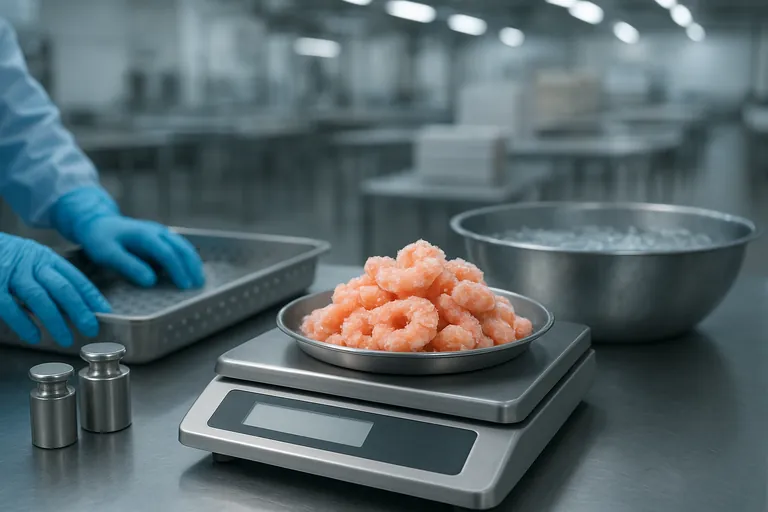
- Bench scale with 0.1 g or 1 g readability, capacity appropriate to pack size.
- Class M1 test weights for daily checks at the start of shift and before official tests. Verify at 100 g and at or near pack nominal (for 1 kg packs, check at 1,000 g). Record results.
- Thermometer for water temperature.
- Plastic mesh trays, timer, lint-free towels, stainless bowl or basin.
Pro tip. I’ve found teams get the tightest repeatability when they log a 3-point scale check before and after tests. It takes 90 seconds and kills most disputes later.
How do you remove ice glaze to measure true net weight on shrimp?
Use a cold-rinse deglazing that melts external ice without cooking the shrimp and without stripping intrinsic moisture.
- Water. Potable water at 10–15°C. Colder is fine. Don’t exceed 18°C.
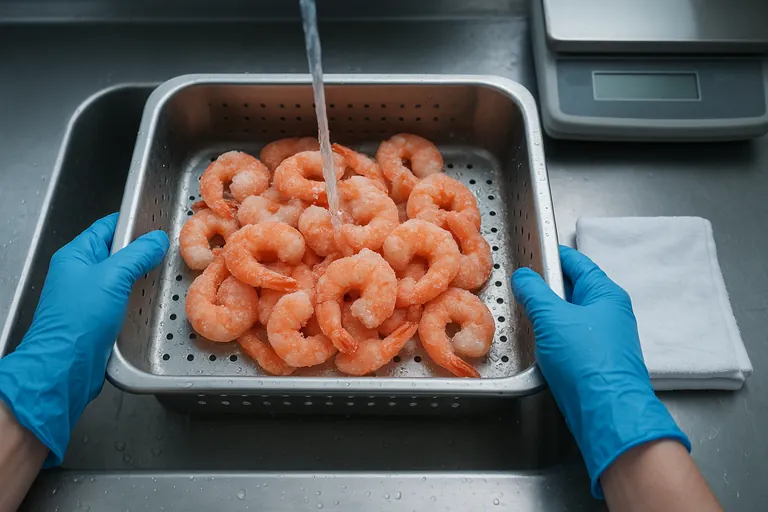
- Rinse method. Submerge unopened pack briefly to free contents if needed. Then empty shrimp into a perforated tray inside a basin. Gently agitate under a low-flow rinse or by swirling in still water. Keep pieces moving so ice melts evenly. Typical time is 30–90 seconds, depending on glaze thickness. Stop as soon as all visible ice is gone.
- Drain. Lift the tray and let it drain for 30 seconds. Give 2–3 gentle shakes to remove surface water. Do not squeeze or press the shrimp.
- Blot. Lightly touch once with a lint-free towel for 3–5 seconds to catch drips.
- Weigh immediately. Record as “Deglazed Net Weight.”
Why this works. The temperature window and short drain time remove protective ice but don’t warm the muscle enough to pull water out or start drip loss. Over-agitation, warm water or long drains inflate loss and will fail a referee test.
Deglazing calculations and acceptance
Measure and record for each unit:
- Pack gross weight before opening (if printed on inner pack) or actual frozen weight if weighed.
- Deglazed net weight (after the rinse, drain, blot steps above).
- Glaze weight = Gross weight minus Deglazed net weight.
- Glaze percentage = Glaze weight ÷ Gross weight × 100.
Acceptance we use in 2026:
- Net weight compliance. The average deglazed net weight of the sample must be equal to or greater than the declared net weight. No systematic shortfall.
- Individual tolerance. For practical control we align with OIML-style tolerable negative error as a yardstick. For a 1,000 g pack, keep each unit within −1.5 percent at minimum. For 500 g, within roughly −1.8 percent. For 200 g, within about −2.7 percent. Your buyer spec may be tighter. Build your house limits 1–2 percent above the label to avoid border cases.
- Glaze control. Hit your spec window, commonly 6–8 percent for IQF shrimp. If you run 10–12 percent for long-haul containers, be transparent with buyers and make sure labels and specs reflect it.
What water temperature and time should be used?
We recommend 10–15°C for 30–90 seconds. Warmer or longer accelerates thaw beyond the glaze. If you see edges softening, you went too far. Reset your timer and train the team to stop the second ice disappears.
What’s the difference between glaze weight and water uptake?
- Glaze weight is the external ice coat. You remove it and exclude it from net weight.
- Water uptake is moisture absorbed by the shrimp during processing, for example from brine or phosphate systems. It remains in the product and is part of net weight, but any additives must be correctly declared in the ingredients. Don’t confuse drip loss on thaw with glaze. They are different checks with different targets.
Labeling shrimp in Indonesia. What to print in 2026
Do I need to print the glaze percentage on the label?
By default you print net weight excluding glaze. Printing glaze percentage is optional unless your buyer or market program requires it. Many of our export customers ask for “Net weight excludes glaze” or “Protective glaze X%” as an informational line. It reduces disputes. If you state a range, keep your process within that range.
Frozen shrimp labeling example
- Main panel. “Net Weight 800 g.”
- Informational note. “Protective ice glaze. Net weight excludes glaze.”
- If customer-required. “Approx. glaze 6–8%.”
Keep declared net weight tied to the deglazed value. Don’t put gross weight on the same panel unless clearly labeled as “Gross.”
Common mistakes we still see, and the easy fixes
- Rinsing too warm or too long. It strips intrinsic moisture. Hold water at 10–15°C and use a timer.
- Inconsistent drain and blot. Set 30 seconds drain plus a quick 3–5 second blot, no squeezing. Standardize it in the SOP.
- Weak sampling. Pull enough packs. The square-root rule and a 15-unit minimum for retail lines catch variability.
- No scale check. Do a quick two-point check with M1 weights at the start and end. Record it. Auditors love it and it saves arguments.
- Label drift vs spec. If you increase glaze for protection in hot seasons, update specs and tell your buyer first. Surprises cause credits.
QC record sheet template fields you can copy
- Product, SKU, size grade, batch/lot, production date.
- Cartons in lot, cartons sampled, units sampled.
- Water temperature, timer used, drain time.
- For each unit. Declared net, measured deglazed net, calculated glaze %, pass/fail.
- Scale ID and calibration checks (weights used and results).
- Average net, average glaze %, min/max units, disposition, QA signature.
We share a bilingual EN–ID template with our partners. If you want a copy, Call us and we’ll send the latest version.
How close does the actual net weight need to be to the label claim?
Our rule of thumb for Indonesia in 2026. The lot average must meet or exceed the label. No individual pack should be short by more than about 1.5 percent at 1 kg, scaling slightly higher for smaller packs. Many buyers adopt even tighter rules, for example “no unit under label by more than 1 percent.” We set our production targets 1.5–2.0 percent above the label to buffer distribution variables.
Where this advice applies, and when to adjust
- Applies. IQF and block-frozen shrimp packed in Indonesia for domestic or export channels that accept Indonesian-origin factory QA tests.
- Adjust. Buyer programs with specific deglaze methods, third-party audit protocols, or markets that require printed glaze percentage. Align your SOP to their method and keep a crosswalk sheet so teams know which version to run.
How we implement this at Indonesia-Seafood
On our shrimp lines, we glaze to customer spec and verify net weight with the method above every hour, plus at start and end of shift. Our Frozen Shrimp (Black Tiger, Vannamei & Wild Caught) program targets a 6–8 percent protective glaze for most lanes. For longer routes we’ll agree a slightly higher band with transparent labeling. If you need comparable control on finfish, our Goldband Snapper Fillet is also available in glazed-frozen format with the same net-weight verification discipline.
Questions about your sampling plan or label text for a new customer? Need us to run a referee deglazing on a retained lot? You can Contact us on email and we’ll share our worksheet and walk your QA through the steps.
Practical takeaway. Keep water cold and timing tight. Standardize drain and blot. Aim for 6–8 percent glaze unless the route demands more. Use a robust sampling plan. And declare net weight that truly excludes the glaze. Do these five and your 2026 audits will be boring in the best possible way.