A practical, Indonesia-specific playbook to build and audit-proof a tuna histamine control plan under FSSC 22000 v6. From vessel cooling to a receiving CCP, EU 2073/2005 sampling, rapid kits vs HPLC, corrective actions, and the exact records auditors want in 2026.
If you process or export tuna from Indonesia, histamine control isn’t a checkbox. It’s the difference between a clean audit and a rejected container. We’ve run programs for chilled and frozen tuna to the EU, US and Japan for years, and the pattern is always the same. If you lock in time-temperature from boat to blast, set a tight receiving CCP, and verify with the right tests, histamine becomes predictable and low-risk.
Here’s a concise, Indonesia-specific guide for 2026 that your QA team can apply tomorrow.
What buyers and auditors will ask first
What is the legal histamine limit for tuna in the EU and US?
- EU (Regulation 2073/2005): For tuna and other high-histidine species, use the 9-unit sampling plan. Average of 9 samples must be ≤ 100 mg/kg. Up to 2 samples may be between 100 and 200 mg/kg. None can exceed 200 mg/kg. For enzyme-matured products, higher limits apply, but most tuna exports fall under the standard limits above.
- US (FDA guidance/CPG): FDA’s guidance level is 50 mg/kg. Many US buyers lock this into specifications, so plan for the stricter 50 mg/kg when shipping to the US.
Takeaway. Set your internal release limits by target market. We keep two specs: EU spec aligned to 2073/2005 and a stricter US spec at ≤ 50 mg/kg.
The backbone: a receiving CCP that actually prevents scombrotoxin
What should I set as the CCP at tuna receiving?
In our experience, one CCP at receiving works best, supported by PRPs and supplier controls. Use these critical limits:
- Fresh/chilled whole or loins. Core temperature ≤ 4°C. No signs of decomposition by trained sensory. Documented time out of refrigeration ≤ 2 hours cumulatively. Ice coverage adequate, no gaping or sour/putrid odor.
- Frozen. Product temperature ≤ −18°C and no thaw/refreeze evidence (excessive drip, snow, soft blocks, ice glaze damage). Packaging intact.
- Documentation. Lot definition is clear. Vessel name/trip dates, harvest area, handling method (RSW/ice), and cooling records supplied.
- Testing trigger. If shipping to the EU or if there’s any temperature deviation or sensory suspect, apply EU 2073/2005 histamine sampling before release.
Monitoring. Every lot. Measure core on a representative number of units from highest-risk pallets first. For frozen, we check at least 1 unit per pallet, minimum 5 per lot. For chilled, probe the largest fish and any with questionable handling.
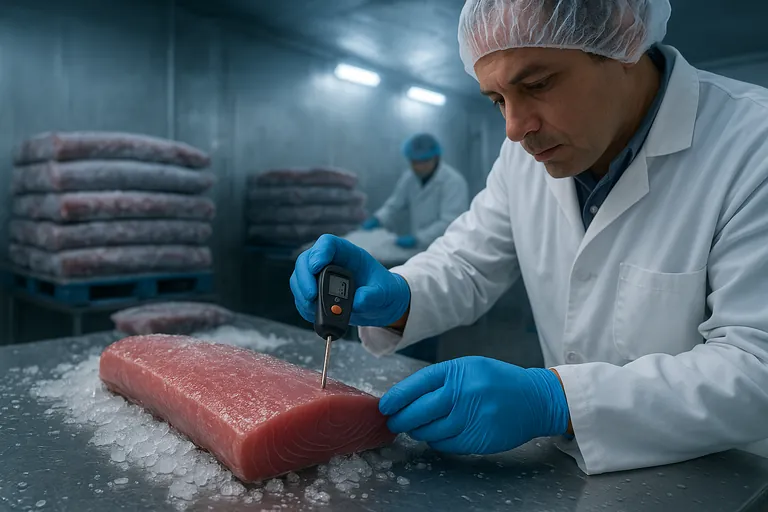
Corrective action. If any limit fails, hold the lot. Move immediately to verification testing and supplier escalation. More on that below.
Getting boats right: Indonesian cooling that actually works
What cooling and icing practices prevent histamine on Indonesian vessels?
Histamine starts on deck. You can’t fix a warm fish later.
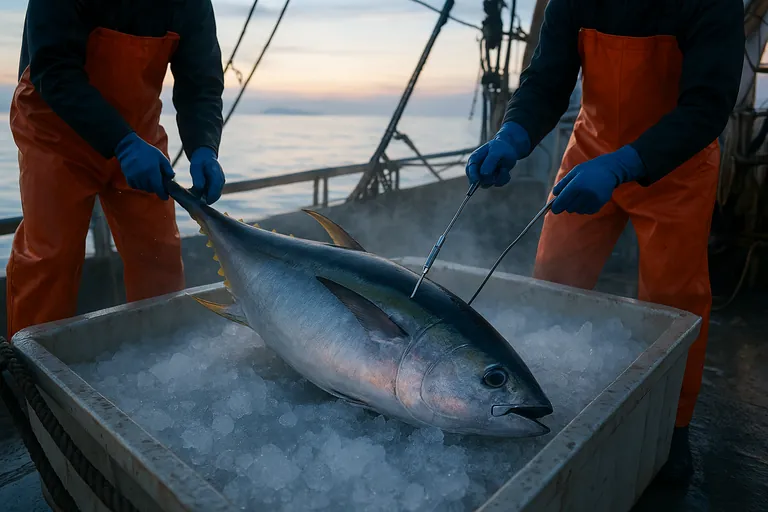
- Time on deck. Bleed and chill within 30 minutes of capture. We insist crews log start and end times per set.
- Pre-chill. Use an ice slurry or RSW at −1 to 0°C. For day boats in tropical heat, a fish:ice ratio around 1:1 by weight is robust for 24 hours. If ice is limited, increase slurry contact and drainage to keep meltwater cold and clean.
- Core cool-down. Target core ≤ 4°C within 6 hours for small skipjack/juvenile yellowfin, and within 12 hours for large yellowfin (>30 kg). Validate this with data loggers inserted behind the pectoral fin into the loin on a few representative fish.
- Gutting. For large tuna, gut promptly and re-pack with flake ice in the cavity. Avoid stacking warm fish in bins.
Pro tip. Don’t rely on ambient hold temperature alone. Validate the time-to-core-cold on your biggest fish. We’ve salvaged entire seasons for suppliers just by fixing this one validation step.
EU 2073/2005, made practical
How many samples per lot for EU 2073/2005?
Nine. Define your lot first. One species, one production date, one vessel or consistent handling method. Then:
- Select 9 primary units spread across pallets, layers and size grades.
- Homogenize portions from dark muscle areas where histamine concentrates.
- Apply the m/c/M criteria noted above (average ≤ 100 mg/kg, max 2 between 100–200 mg/kg, none > 200 mg/kg).
If mixed-species scombroids arrive together, treat each species as its own lot. If you absolutely must combine, sample proportionally and apply the strictest acceptance criteria.
Rapid kits vs accredited methods
Are rapid histamine test kits acceptable under FSSC 22000?
Rapid colorimetric or lateral-flow kits are excellent for on-site screening and CCP verification. We use them to make quick release decisions when temperature histories are clean. For EU exports and disputes, confirm positives or borderline results using an accredited method such as HPLC performed by an ISO 17025 lab. Keep a quarterly correlation check. Compare your in-house kit results with accredited lab data and document the agreement.
Practical split. Screen all lots in-house when risk is elevated. Confirm only when close to limits, any unit fails, or as required by customer specs.
Handling failures without making them worse
What corrective actions are required if a tuna lot fails histamine limits?
- Immediate hold. Stop use and block shipment. Mark clearly in inventory.
- Verification. Re-test using accredited HPLC on retained samples. Don’t average in new fish or blend lots. That’s a fast track to rejection.
- Traceback. Identify the vessel trip, fishing areas, and time-temperature records. Expect a root cause in deck time or delayed chilling.
- Disposition. If any EU sample exceeds 200 mg/kg, the lot fails EU criteria. Options are downgrade to non-EU markets with stricter review, divert to fully cooked applications where allowed by law and customer spec, or condemn. For US, any unit ≥ 50 mg/kg is usually unacceptable for raw/cooked distribution.
- Prevent recurrence. Retrain crew and receivers, fix cooling capacity or ice logistics, tighten supplier approval status, and increase sampling for the next 3 compliant lots from that source.
We’ve found that quick, honest communication with buyers beats quiet fixes. It builds trust, and it’s the right thing for food safety.
Documentation that satisfies FSSC 22000 v6 auditors in 2026
How do I document histamine control to pass audits?
Auditors in 2025–2026 are asking for objective evidence, not promises. Maintain:
- Hazard analysis. Clear rationale for scombrotoxin hazard severity and likelihood, with vessel-to-receiving controls.
- CCP plan. Defined limits, monitoring method and frequency, who is responsible, calibration of probes and kit lot numbers.
- Receiving records. Core temperatures, sensory checks, ice coverage, time-out-of-cold-chain, photos when relevant.
- Histamine testing records. EU sampling sheets with unit maps, chain of custody to accredited labs, kit validation files and quarterly correlation checks.
- Supplier approval. Vessel handling SOPs, ice/RSW capacity, crew training, cooler logs, nonconformance history, and re-approval criteria.
- Validation. Time-to-core-cold studies using data loggers on largest fish, blast-freeze validation curves, and thawing controls for rework.
- Verification and internal audit. Trend charts of histamine and temps, corrective action closure, and management review minutes that show you acted on trends.
- Training. Annual competency for dock, QC and sensory staff with practical scenarios. Keep sign-in sheets and quizzes.
FSSC 22000 v6 put more emphasis on food safety culture and evidence of effectiveness. Show trends, not just checklists.
Details most teams miss (and the simple fixes)
- Define your lot narrowly. We see too many “mega-lots” spanning vessels and dates. Keep it tight so sampling actually reflects risk.
- Probe the right spot. Core probes should go into the loin’s thickest section. And don’t forget to sanitize between fish. Cross-contamination can spoil your data.
- Watch thaw-and-refreeze. Histamine won’t decrease with freezing, and it can continue forming if fish warms up during handling. Control time and temp during trimming and portioning.
- Train sensory properly. Decomposition cues are subtle on tuna. A periodic blind panel with known good/bad references keeps your team sharp.
Where our products fit into rigorous histamine control
Many of our export tuna SKUs rely on this exact system, especially Yellowfin Saku (Sushi Grade), Yellowfin Steak and Bigeye Loin. For skipjack applications, we apply the same controls to Skipjack Cube (WGGS / IQF). If you’re building category specs, these are solid references for handling and release criteria.
Need a second pair of eyes on your sampling plan or CCP limits? We’re happy to compare notes and share templates. You can Contact us on whatsapp.
Quick-reference: set-up checklist for your team
- Receiving CCP. Chilled ≤ 4°C core. Frozen ≤ −18°C. Sensory pass. Time-out-of-chill ≤ 2 hours cumulative.
- EU 2073/2005 sampling. n=9 per lot, spread across the lot. Average ≤ 100 mg/kg. Max 2 between 100–200 mg/kg. None > 200 mg/kg.
- Rapid kits vs HPLC. Use kits for screening and speed. Confirm borderline/failures at ISO 17025 labs. Keep quarterly correlation checks.
- Vessel controls. Chill to core ≤ 4°C within 6–12 hours depending on size. Maintain ice/RSW capacity, log deck times.
- Records to keep. Lot definitions, temperature logs, histamine results, supplier approvals, validation studies, training files, trend charts.
What’s interesting is how predictable histamine becomes once boats, receiving, and verification are aligned. We’ve seen claim rates drop to near zero in a single season just by tightening lot definition and validating core cool-down. That’s the level of control buyers reward in 2026.
If you’re standardizing specs across multiple plants or co-packers, we can share our receiving forms and sampling maps. Or, if you’re scoping new lines for tuna in retail or foodservice, you can also View our products to see how we align specs with market requirements before you write your HACCP plan.