A practical, step-by-step playbook to execute the EU n=9, c=2 histamine sampling plan on Indonesian tuna, choose the right test method, and issue a COA that clears EU border checks in 2026.
We’ve cleared hundreds of EU-bound containers of Indonesian tuna since 2016, and the n=9, c=2 rule still trips people up. One missing gram of sample, one composite number in place of 9 unit results, and you are looking at a detained load. Here’s the exact system we use on our lines and with partner plants across Indonesia.
The EU rule in plain language
What is the EU n=9 c=2 histamine rule for tuna, in simple terms?
For tuna and other high-histidine fish, Regulation (EC) 2073/2005 sets an acceptance plan of n=9 and c=2. In practice:
- Test 9 individual units from the lot.
- The mean of the 9 results must be at or below 100 mg/kg.
- A maximum of 2 individual results may fall between 100 and 200 mg/kg.
- No individual result may exceed 200 mg/kg. If any single unit is over 200 mg/kg, the lot fails. If more than 2 units are between 100 and 200 mg/kg, the lot fails. For tuna, this is the rule to live by.
How to sample frozen or chilled tuna the right way
I’ve found that most problems start before the lab ever touches the sample. The sampling pattern matters more than people think because histamine can be patchy.
-
Define the lot clearly. Same species, format, production date or continuous shift window, same processing conditions, and stable cold chain. Keep lots practical. Mixing multiple production days into a single histamine lot invites trouble.
-
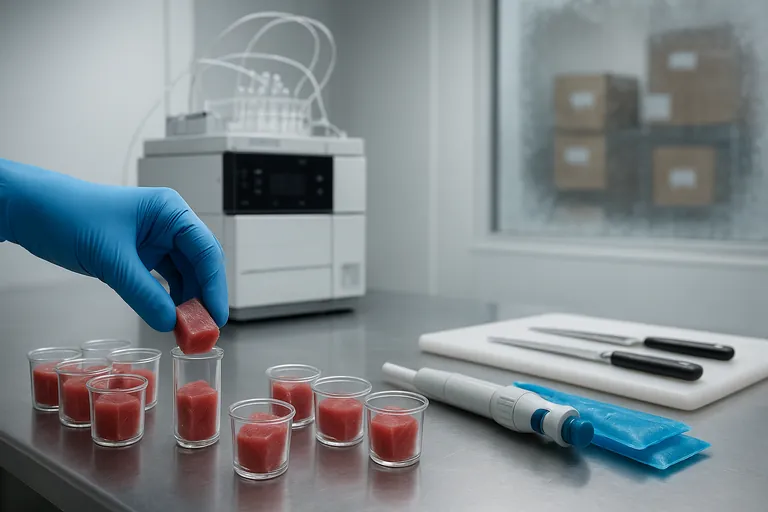
Draw 9 units that represent the whole lot. Spread across pallets, top and bottom layers, front and back of the cold room. If you only sample the prettiest loins on the top layer, you are gaming yourself.
-
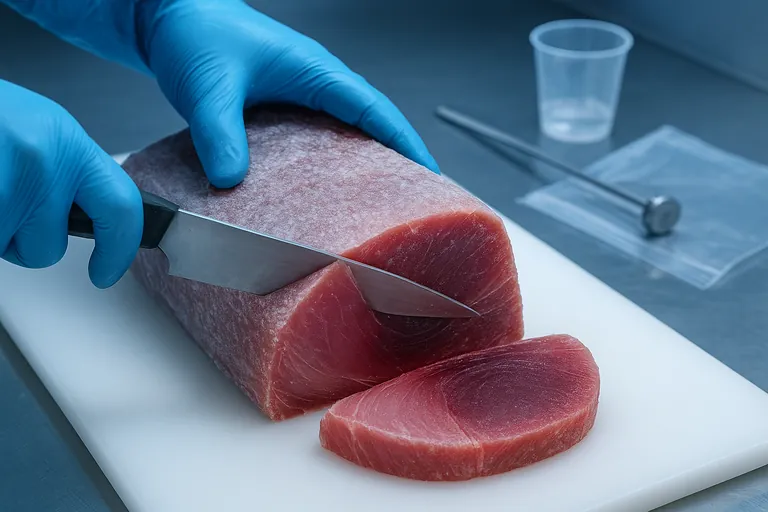
Keep samples cold. For frozen tuna, sample while still semi-frozen at 0 to minus 5 C. Avoid running water or microwaves. Use clean, sanitized knives. Record fish temperature at sampling.
-
Take enough mass per unit. Labs can work with small aliquots, but you need working margin for duplicates and potential referee tests.
How many grams should I take from each of the 9 sample units?
We recommend 100 g per unit as a minimum. For large loins or steaks, cut a 100 g wedge that includes surface, mid, and core. That cross section reduces false highs or lows caused by localized histamine pockets. If your lab asks for more, send 150 to 200 g per unit to be safe.
Can I make one composite from the 9 tuna samples for the EU test?
Short answer. Do not rely on a single composite for EU acceptance. The regulation requires 9 unit results to check both the mean and the count of results above 100 mg/kg. Practical approach. Many labs allow three composites of three units each for initial screening. If any composite breaches limits, you retest the three individual units in that composite to identify which ones failed. For border checks, we routinely submit 9 individual results on the COA. EU BCPs have been asking more often in 2025 and 2026 to see all nine values.
Thawing and cutting tips that prevent rework
- Sample semi-frozen. You get cleaner cuts and less enzymatic activity.
- De-glaze gently. If product is glazed, scrape glaze without warming the flesh.
- Use single-use gloves and disinfect your cutting board between units.
- For Yellowfin Saku (Sushi Grade), take a diagonal wedge across the block. For Bigeye Loin or Yellowfin Steak, include both red and pale zones in the cut. These small details save days at the border.
Methods that EU inspectors actually accept
Which histamine methods do EU inspectors accept, HPLC or enzyme kits?
EU reference practice is HPLC with fluorescence detection. Labs following ISO 19343 or an equivalent validated HPLC method are widely accepted. Enzymatic or ELISA kits are excellent for in-plant screening, but for official control and COA you should use HPLC or a method demonstrably equivalent and accredited to ISO 17025.
Are rapid histamine kit results enough for EU border checks, or do I need HPLC confirmation?
Rapid kits help you sort good from questionable lots in minutes. We use them daily on the floor. But they are not enough for EU border clearance. If you pre-screen with a kit and the numbers are tight near 100 mg/kg, send HPLC confirmation before loading. In the past 6 months, we’ve seen BCPs in Italy, Spain, and the Netherlands ask for chromatograms when results hover near decision points.
Practical takeaways.
- Use rapid kits to screen. Ship only after an HPLC COA is issued for the lot.
- Make sure the lab is ISO 17025 accredited for histamine.
- Keep instrument raw data on file for 12 months. It gets asked for more often than you think.
COA that clears the EU border the first time
How do I define a lot and link it to my container on the histamine COA?
The lot definition on the COA must match your production and packing records. We structure it like this:
- Lot code. Species code plus production date and shift. Example. YF-2026-01-15-A.
- Product ID and form. For example, Yellowfin tuna saku, IVP.
- Quantity covered by the lot. Number of cartons and net weight.
- Container mapping. List which container numbers carry which lots. If a container mixes lots, show the split by carton count and weight.
- Trace elements. Vessel or raw material lot, processing plant code, storage temperature record.
If you need a template COA with container mapping and nine-unit results in a clean layout, just ask and we’ll share ours. If you are wrestling with a specific shipment, you can Contact us on whatsapp. We’re happy to sanity check your draft.
What to put on the COA itself.
- Nine individual results and the calculated mean.
- Method and lab accreditation. State HPLC method and ISO 17025 scope.
- Sample date, analysis date. Sampling must precede loading.
- Lot definition and container numbers.
- Signature and stamp of the lab. I also like attaching the sampling record with pallet IDs and photos. Some BCP officers actually read them.
Acceptance decisions with real numbers
What happens if one unit is over 200 mg/kg but the average is below the limit?
The lot fails. Example. Nine results are 48, 61, 72, 85, 92, 104, 118, 131, 215 mg/kg. The average is 103 mg/kg, but a single unit at 215 mg/kg exceeds 200 mg/kg. Under n=9 c=2, that is unsatisfactory. No workaround exists.
Two more examples you can use in QA training.
- Pass example. 55, 67, 72, 80, 88, 95, 110, 130, 140 mg/kg. Mean 93 mg/kg. Two units between 100 and 200 mg/kg. Pass.
- Fail example on mean. 70, 82, 95, 98, 101, 115, 120, 130, 140 mg/kg. Three units above 100 mg/kg and the mean is 106 mg/kg. Fail. These drills make the rule easy to apply at the floor level.
Indonesia-specific execution, labs, and timelines
Here is how we keep timelines tight without gambling at the border.
- Labs and turnaround. ISO 17025 accredited labs in Indonesia routinely deliver HPLC histamine in 2 to 3 working days. Same day or next day is possible if you pre-book. Build this into your vessel ETA and stuffing schedule.
- Chain of custody. Use tamper-evident bags for the 9 units, with a sampling form listing product, lot, temperature, sampler, and time. Sign across the seal. It sounds fussy, but it avoids disputes later.
- BKIPM coordination. Align your sampling with BKIPM inspection slots so your health certificate and COA travel together. When these documents match, EU border posts process faster.
Three non-obvious tips that pay off.
- Cross-sectional wedges. On loins and sakus, always cut through surface and core in each 100 g unit. You will catch localized spikes before the BCP does.
- Photo log and pallet map. We attach two photos per unit and a pallet map. When a BCP asks for clarification, you answer in minutes, not days.
- Parallel screening. Run rapid kits in-house while the HPLC samples are en route. If the screen flags a risk, you can hold back the lot before it snowballs into a container problem.
Where this advice applies and where it doesn’t. This guide covers standard tuna products, raw and frozen. It does not cover enzyme-ripened fish in brine, which operate on a different upper tolerance for histamine under EU law. If you are exporting anchovy-like products, use the specific criteria for that category.
Common mistakes that trigger EU detentions
- Submitting only a single composite value for the lot. EU wants 9 unit results.
- Sampling after stuffing. BCPs are increasingly checking that sample dates are before loading.
- Using a non-accredited method on the COA. Rapid kits are great for screening but not for official proof.
- Weak lot definitions. If your COA lot cannot be matched to the container manifest, expect questions.
- Forgetting the mean. Teams sometimes check only the count above 100 mg/kg and miss that the average exceeded 100 mg/kg. Fix these, and you cut 90 percent of predictable histamine headaches.
Resources and next steps
If you need a ready-to-use SOP, we can share our n=9, c=2 sampling worksheet, COA template, and a simple calculator that flags pass or fail based on your nine values. And if you want to see how we apply this on export-ready tuna formats like Yellowfin Saku (Sushi Grade) or Yellowfin Steak, you can also View our products.