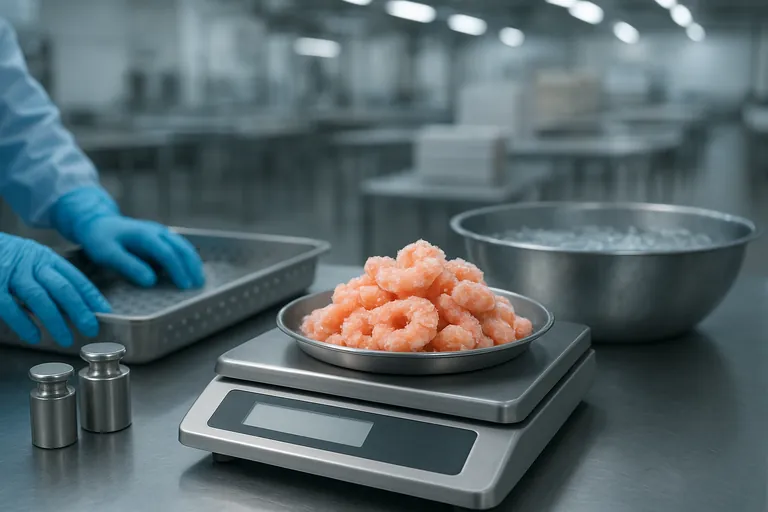
A practical, step-by-step guide to CFIA net weight and ice glaze rules for frozen shrimp and IQF seafood shipping from Indonesia to Canada in 2025. How to label correctly, how inspectors deglaze, what tolerances apply, and the simple calculations that keep your lots off hold.
If you ship frozen shrimp or IQF seafood to Canada, the fastest way to lose time and money is a short-weight hold. We’ve been through the audits, the rework, the late-night calls with importers. This guide is our playbook for getting CFIA frozen shrimp net weight right in 2025. It’s practical, tested, and focused on what CFIA actually checks.
The core rule: net quantity must exclude ice glaze
Does CFIA require the net weight to exclude ice glaze on frozen seafood?
Yes. In Canada, the declared net quantity for glazed frozen seafood must exclude ice glaze. That’s your “drained” deglazed weight after the ice is removed. Declaring “1 kg including glaze” is non-compliant for the net quantity statement.
What you can do. Use a clear net quantity statement on the principal display panel (PDP):
- “1 kg” or “Net 1 kg | Poids net 1 kg.” The unit symbol (g/kg) is bilingual by nature.
- Optional information like “10% glaze added” can appear elsewhere, but it can’t look like the net quantity.
What CFIA tests in real life
How does CFIA test net weight on glazed shrimp, and what happens if it’s short?
Inspectors remove the ice glaze, then weigh the product. The deglazing follows an AOAC-style method. Gentle rinse in cool water until the glaze is gone. Brief drain and blot. Then weigh to determine the true net weight excluding glaze.
They sample multiple retail units from your lot and apply Canada’s “average system.” The average deglazed weight must meet or exceed the label. Individual packages can have small deficiencies, but none may exceed the Maximum Allowable Deficiency (MAD). For 500 g packs the MAD is roughly in the 3–4.5% range. The exact allowance depends on the declared quantity and the table CFIA uses.
If the average fails or too many units are below the MAD, the lot can be detained. Importers may face enforcement actions and you’ll be asked to relabel, rework, or even return product. We’ve seen holds resolved in 2–3 weeks when documentation and rework are ready. But they can drag if you’re improvising.
Practical takeaway. Build a small positive bias into your deglazed target weight and routinely verify with an in-house deglaze check.
Labels: what to print, where to put it, how big it must be
Do I have to print the glaze percentage on the label in Canada?
No. CFIA doesn’t require a glaze percentage on pack. Many brands still show it because buyers ask. If you do list it, make sure it is clearly separate from the net quantity statement and not more prominent.
What font size and placement are required for the net quantity statement on shrimp packs?
- Placement. The net quantity must appear on the principal display panel. Keep it clear, prominent, and easy to read in a single line when possible.
- Bilingual. Use “g” or “kg” symbols or provide English/French wording. “1 kg” alone is acceptable because the symbol is bilingual. “Net weight/Poids net” is a good belt-and-suspenders approach.
- Type size. Minimum character height for the numerical part depends on the principal display surface area (PDSA). For most 400–1000 g retail pouches, the minimum numeral height is typically 3.2 mm, with the unit at least 1.6 mm. Larger panels require larger numerals. Measure your PDSA and confirm against CFIA’s table before print.
Helpful reference. CFIA’s Industry Labelling Tool explains the net quantity rules and type sizes clearly. We keep it bookmarked. See: CFIA Industry Labelling Tool – Net quantity
Can I show ounces, or must net weight be metric-only in Canada?
Metric is mandatory and must be primary. You may add ounces as supplementary information in parentheses, as long as the metric declaration is at least as prominent. Example: “500 g (17.6 oz)”.
Where should I place the bilingual net quantity statement on the principal display panel?
Put it on the front panel that consumers see first. Keep it in a contrasting color, aligned and parallel to the base, and not crowded by graphics. Simple and readable beats clever design. Your QA manager will thank you.
Short-weight risk control: the numbers that keep you safe
What target fill weight should I use when applying ice glaze so I don’t fail CFIA’s check?
Here’s a simple way we calculate targets for frozen shrimp. Let’s assume a 1 kg declared net weight, with a planned 10% glaze and 1–2% expected handling loss before inspection.
- L = label net weight excluding glaze (e.g., 1000 g)
- G = glaze fraction (e.g., 0.10)
- E = expected pre-inspection loss (e.g., 0.02)
- Target deglazed weight at pack = L × (1 + E)
- 1,000 g × 1.02 = 1,020 g
- Gross frozen weight including glaze at pack = Target deglazed ÷ (1 − G)
- 1,020 g ÷ 0.90 = 1,133 g
In practice, we set an in-process control range. For a 1 kg net pack with 10% glaze, we target 1,020–1,030 g deglazed at pack and checkweigh to hold Cpk. That usually keeps lots clean even after some dehydration in distribution.
Two non-obvious insights from the floor.
- Control deglazed weight, not just gross weight. Gross weight is noisy because glaze fluctuates. Calibrate your checkweigher on deglazed targets using routine in-house deglaze tests.
- Chill your deglaze water and keep timing consistent. Warmer or longer rinses strip more than just glaze. Inconsistent technique creates false fails in your own lab and your operators start ignoring the data.
Need help sizing a target for your spec? Send your label weight, glaze plan, and pack format. We’ll run a quick scenario for you. You can Contact us on whatsapp.
What you can and can’t fix after arrival
Can my Canadian importer relabel after arrival to correct a net weight mistake?
For label errors like missing French or the wrong unit, yes. Importers can relabel before sale under CFIA oversight. For short-weight, relabeling doesn’t solve the problem unless every unit still meets a revised lower declaration and pricing reflects it. Often the practical route is rework or return. We advise fixing net quantity and glaze execution at source.
Drained weight, glaze percentage and other common confusions
Does drained weight apply to frozen shrimp or only canned products in Canada?
“Drained weight” is for solid foods in liquid media, like canned tuna in brine. It doesn’t apply to frozen shrimp. For frozen shrimp, you declare net weight excluding glaze. If you include a glaze note, label it clearly as “glaze added.”
Do I have to list “ice glaze exclusion” explicitly on the label?
No. The rule applies by definition. Many brands still add a clarifying line like “Net weight excludes ice glaze” to reduce disputes. We do this often for private label buyers.
Common mistakes we see on Indonesian shrimp labels for Canada
- Printing “1 kg including glaze.” Non-compliant. The declaration must exclude glaze.
- Ounces shown bigger than grams. Metric must be primary and at least as prominent.
- Tiny numerals. A typical 500 g pouch needs numerals at least 3.2 mm tall. Measure your panel.
- Glaze stated as a range like “8–15% glaze.” Operationally true, but it raises questions. If you show it, stick to a tight target and hit it.
- No bilingual cue. “1 kg” alone is fine, but if you spell out words, include English and French.
A quick QC checklist before shipping to Canada
- Confirm PDP area and type size. Check numeral height and unit height against CFIA’s table.
- Verify metric-first net quantity. Ounces only as supplementary in smaller or equal prominence.
- Freeze plan locked. Pick a glaze target and SOP. Document chill water temperature, rinse time, drain time.
- In-house deglaze test. Pull a sample of finished retail units. Deglaze and weigh. Confirm the average meets or exceeds the label and no unit approaches the MAD.
- Checkweigher limits tied to deglazed targets. Don’t chase gross weight only.
- Carton and unit labels match. Avoid cases labeled “12 x 1 kg” when retail units average 980 g deglazed.
- Photos and records. Keep photos of panels, batch records, and deglaze logs. It speeds resolution if inspected.
When this advice applies, and when it doesn’t
You’re in the right place if you sell consumer-prepackaged frozen shrimp or IQF seafood to Canada. If you’re shipping bulk master cartons for further processing in Canada, the buyer’s rework will change the labeling responsibility. Different rules apply to fish in water or brine. And nutrition facts, SFC licenses, species naming and origin statements are separate topics.
Putting it into practice with our products
We run the same controls across shrimp and IQF finfish. For example, our Frozen Shrimp (Black Tiger, Vannamei & Wild Caught) packs follow deglazed net targets with documented in-house deglaze checks. The same discipline applies to IQF fish like Grouper Fillet (IQF) and Mahi Mahi Fillet. If you need private-label packs tuned to a specific glaze and type size, we can align spec, artwork, and floor SOP so CFIA checks go smoothly.
Questions about your current spec or a recent short-weight dispute? Share the label panel and your glaze SOP. We’ll help you troubleshoot and set safe targets. You can also View our products if you’re scoping items for a new line.
Final takeaways for 2025
- Declare net quantity excluding glaze. Keep metric primary and correctly sized.
- Control deglazed weight with a small positive bias. Verify with a consistent in-house deglaze test.
- Treat ounces, glaze percentage, and bilingual cues carefully so they never overshadow the net quantity.
- Plan for the average system and MAD. Aim to exceed the label by 1–3% at pack, depending on your dehydration risk.
In our experience, three out of five short-weight issues come down to two simple fixes. A better in-process deglaze SOP and a realistic target fill. Nail those and CFIA checks stop being stressful, which is exactly how it should be.