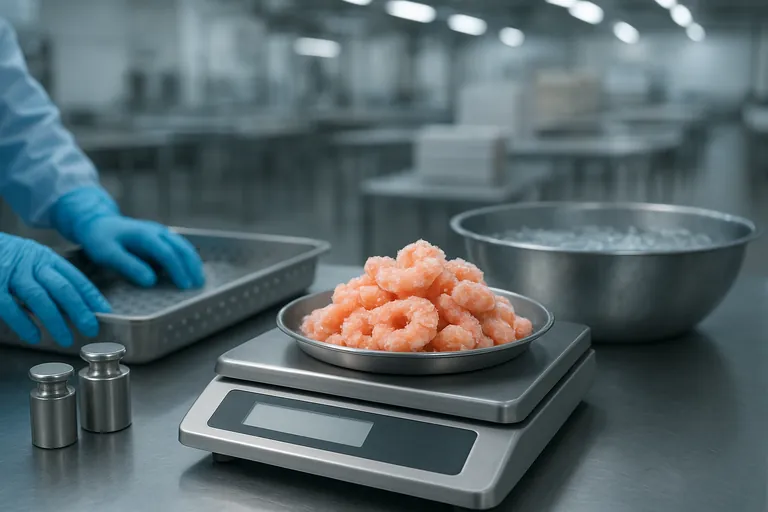
A practical, step-by-step system to calculate true landed cost per usable kilogram (and per portion) for Indonesian vannamei shrimp across IQF, IVP, and block. We cover glaze percentage, drip loss, freight, duty, and labor—plus simple formulas and a worked example you can copy.
The hook: how we saved $10,247 in 90 days using this cost system
We once audited three shrimp SKUs for a mid-size buyer who swore “block is always cheaper.” By week 12, they’d stopped paying for unneeded glaze, cut thaw loss by 1.4 points, and re-specified pack formats. The difference on 2 x 20’ mixed containers over a quarter? $10,247 saved. The math isn’t glamorous. But it’s repeatable.
This guide shows the exact worksheet we use to compare IQF vs IVP vs block frozen Indonesian vannamei, so you can buy on cost per usable kilogram and per portion, not on FOB headlines.
The 3 pillars of true shrimp cost
In our experience, every smart comparison balances three drivers:
-
Weight reality. You pay for glaze in logistics. You sell and cook the drained weight. The gap is drip loss. If you don’t normalize to “usable kg after thaw,” you’re guessing.
-
Logistics and duty. Freight and insurance are charged on physical weight and cube. Duty is usually ad valorem on CIF value, while any specific-by-weight charges, where applicable, are normally on net/drained weight. The only way to be sure is to model both weights and confirm with your customs broker.
-
Labor and portion control. Block can look cheap per net kg but expensive once you factor defrost time, de-blocking, breakage, and inconsistent counts. IVP can add pack cost but save prep minutes and reduce shrink. IQF often sits in the middle.
Practical takeaway: Always compare formats on “landed cost per usable kg” and “cost per portion,” then add or subtract labor deltas in the kitchen or plant.
Week 1–2: Build your landed-cost worksheet
Start with a spec you can pull from any supplier quote of Indonesian vannamei shrimp.
- Price per net kg (P)
- Glaze percentage on pack (G)
- Expected drip loss on thaw (D)
- Freight per kg charged on gross weight (F)
- Duty rate on CIF (R)
- Port/Docs/Insurance per net kg (O)
- Labor/handling delta vs your baseline (L). Positive if it costs more time. Negative if it saves time.
Now set your formulas:
- Gross kg per net kg = 1 / (1 − G)
- Freight per net kg = F × [1 / (1 − G)]
- Duty per net kg ≈ R × (P + Freight per net kg). For ad valorem regimes that assess duty on CIF value.
- Landed cost per net kg before drip = P + Freight per net kg + Duty per net kg + O
- Usable kg factor = (1 − D)
- Landed cost per usable kg = [Landed cost per net kg before drip] / (1 − D) + L
If you portion by weight, cost per 100 g = 0.1 × Landed cost per usable kg. If you portion by count (31/40), consider that drip loss doesn’t change count, only average piece weight. For menu builds, we recommend modeling by weight to avoid “mystery shrink.”
Need help plugging in your variables? We can share our worksheet and run your exact specs. If helpful, contact us on whatsapp.
Week 3–6: Validate glaze and drip with a simple thaw-yield test
Quotes are one thing. Real thaw yield is another. Here’s the field test we recommend:
-
Sample size: 3 packs per SKU. Record pack claim, net weight, and glaze %.
-
Thaw: Overnight at 0–2°C on perforated trays. Do not soak. Drain 20 minutes.
-
Weigh drained product. Drip loss D = (net weight − drained weight) / net weight.
-
Cross-check count accuracy. For 31/40, target 31–40 pcs per net kg. More than 2 pcs outside spec is a red flag.
Typical ranges we see when handling is correct:
- IVP shrimp: D = 0.5–2.0%. Glaze 0–2%.
- IQF shrimp: D = 1.0–3.0%. Glaze 6–10% common, up to 12% for long haul.
- Block-frozen shrimp: D = 2.5–5.0%. Glaze 0%. Higher drip if rushed or soaked.
Quick win: Most unnecessary drip comes from warm-room thawing and soaking. Keep it cold. Thaw in single layers. Drain, don’t soak. You’ll often pick up 0.5–1.0 points of yield.
Week 7–12: Scale and optimize
After your pilot tests, lock three levers:
- Glaze caps in contracts. For IQF, we cap at 8–10% depending on voyage length. For IVP, specify max 2% protective glaze or none. For block, 0% glaze.
- Freight assumptions by format. IQF has higher gross weight due to glaze and slightly lower cube density. Block cubes out well. IVP sits between. Model these differences explicitly.
- Labor norms. Block adds de-blocking minutes and more handling. IVP often saves time in portioning and slacking. Assign a dollar figure per kg. Then hold to it.
At this point, you can compare Indonesian formats apples-to-apples across suppliers.
Worked example: 31/40 Indonesian vannamei, three formats
Assumptions for one “net kg” of product. Values are illustrative but realistic for 2026.
- Duty rate (R): 5% on CIF. Port/Docs/Insurance (O): $0.10/kg net.
- IQF
- P = $6.20/kg. G = 10%. D = 2%. F = $0.60/kg gross. L = $0.00/kg.
- Gross per net = 1/0.90 = 1.111. Freight per net = 0.60 × 1.111 = $0.667.
- Duty = 5% × (6.20 + 0.667) = $0.343.
- Landed cost before drip = 6.20 + 0.667 + 0.343 + 0.10 = $7.310.
- Landed per usable kg = 7.310 / 0.98 = $7.46. Cost per 100 g = $0.746.
- IVP
- P = $6.50/kg. G = 2%. D = 1%. F = $0.60/kg gross. L = −$0.10/kg labor saving.
- Gross per net = 1/0.98 = 1.020. Freight per net = 0.60 × 1.020 = $0.612.
- Duty = 5% × (6.50 + 0.612) = $0.356.
- Landed cost before drip = 6.50 + 0.612 + 0.356 + 0.10 = $7.568.
- Landed per usable kg before labor = 7.568 / 0.99 = $7.64.
- After labor saving L = −$0.10: $7.54. Cost per 100 g = $0.754.
- Block frozen
- P = $5.80/kg. G = 0%. D = 3.5%. F = $0.55/kg gross. L = +$0.35/kg extra handling.
- Gross per net = 1.000. Freight per net = $0.55.
- Duty = 5% × (5.80 + 0.55) = $0.318.
- Landed cost before drip = 5.80 + 0.55 + 0.318 + 0.10 = $6.768.
- Landed per usable kg before labor = 6.768 / 0.965 = $7.01.
- After labor L = +$0.35: $7.36. Cost per 100 g = $0.736.
What’s interesting is the spread compresses once you include real-world labor and drip. Block looks cheapest per kg, but operationally it can be a wash with IQF and IVP for many buyers. If your kitchen is tight on labor or you need tight count control, IVP may win despite a higher FOB.
Questions buyers ask us all the time
How do I calculate cost per usable kg after glaze and drip loss?
Use the worksheet above. Short version:
- Landed per usable kg = [P + F × (1/(1−G)) + R × (P + F × (1/(1−G))) + O] ÷ (1−D) + L
Plug in your numbers and compare formats on the same basis.
What glaze percentage should I accept on Indonesian IQF shrimp in 2026?
We recommend 6–10% for IQF. Closer to 6–8% for short voyages and stable cold chains. Up to 10–12% only if transit risk is high. IVP is typically 0–2% since vacuum protects against dehydration. Block is 0%.
Common mistake: paying for 12–15% glaze “just to be safe.” That often adds freight and reduces line efficiency with no real quality benefit.
Does IVP really reduce thaw loss compared to IQF or block?
Usually yes. Vacuum limits dehydration and micro ice damage. In our tests:
- IVP: 0.5–2.0% drip.
- IQF: 1.0–3.0% drip.
- Block: 2.5–5.0% drip.
The gap gets wider if thawing is rushed or warm. Handle any format correctly and you’ll narrow the spread.
Do I pay freight and duty on glazed weight or net weight?
- Freight and airline/steamship charges are based on physical weight or dimensional weight. That means glazed weight plus packaging, not just net product.
- Duty. Most major markets assess ad valorem duty on the CIF value. Glaze itself isn’t dutiable as a separate line, but over-glaze inflates gross freight and can change the declared value if your pricing is tied to packed weight. Where duties are specific per kg, they’re normally computed on the net product weight (excluding glaze and packaging). Always confirm with your broker for your HS code and destination.
How does block-frozen shrimp impact labor and portion control costs?
Block needs time and space to slack properly. You’ll spend minutes per block separating pieces. There’s more risk of breakage and more variability in piece size unless your team is meticulous. That shows up as:
- Extra handling cost per kg.
- Inconsistent portion sizes if you portion by count.
Block can be ideal for processing lines or surimi. For fast-casual kitchens and retail repack, IQF/IVP usually runs cleaner.
When is IVP worth it over IQF or block?
- You portion by weight and need consistency.
- You’re tight on labor and want faster slacking with minimal drip.
- You care about retail-ready appearance and shelf life after slacking.
If those aren’t priorities and you have robust prep time, IQF is often the value choice. If you run an industrial kitchen and can manage thaw protocols tightly, block can be cheapest on a per-kg basis.
Two non-obvious insights from recent projects
- Negotiate glaze caps and thaw-yield clauses together. If you cap glaze but ignore drip, the supplier can meet the spec and you still lose yield. We put both into contracts with test methods attached.
- Model cube-out, not just weight. Block pallets cube better, which can drop ocean freight by 5–10% per net kg versus high-glaze IQF. In 2025–2026, as reefer rates stabilized and space tightened seasonally, this spread mattered again.
5 mistakes that kill shrimp budgets
- Comparing FOB prices across formats without normalizing for glaze and drip.
- Letting suppliers declare “approximate glaze” without a maximum and test method.
- Thawing blocks in ambient water baths. It spikes drip loss.
- Ignoring labor in business cases. Five minutes per block adds up on a busy Friday.
- Buying 31/40 by count for a weight-based menu. Standardize on drained-weight portions.
Resources and next steps
If you need a flexible pack plan, our Frozen Shrimp (Black Tiger, Vannamei & Wild Caught) covers IQF and block options, with glazing tailored to voyage length and your thaw protocol. For formats where portion control matters most, our IVP and IQF whitefish lines, like Cobia Fillet (IVP / IQF) and Snapper Fillet (Red Snapper), follow the same yield-first approach.
Curious how the numbers look on your lane and spec? Send your quote sheet, and we’ll run it through our calculator and share a side-by-side comparison. The fastest way is to contact us on whatsapp. Or browse current options and formats here: View our products.
We’re biased toward Indonesian supply, of course. But the math works anywhere. Buyers who standardize on landed cost per usable kilogram make fewer mistakes and hit their margins more consistently. That’s the real win.