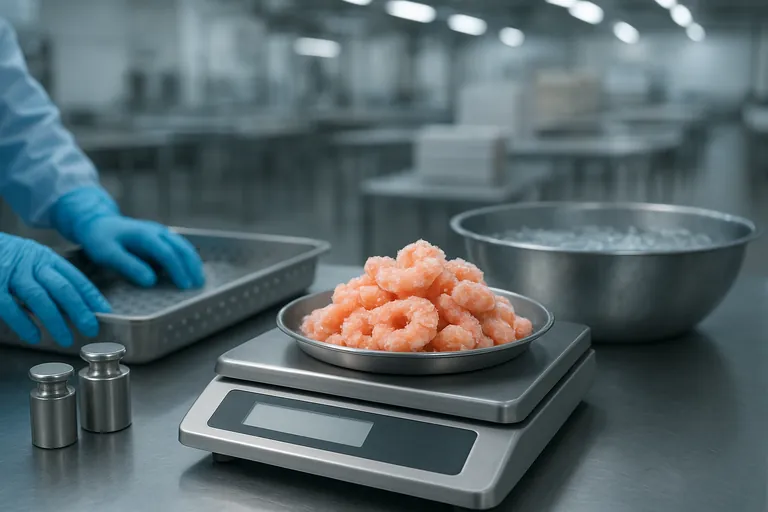
A practical 2025 playbook for building landed cost on Indonesian breaded vannamei shrimp. See how spec choices (breading %, count size, par-fry, pack, certifications, freight) move your FOB Surabaya and CIF price, with a step-by-step model you can copy.
We see the same thing every season. A buyer sets a target price, then misses it by 40 cents per kilo because of two lines in the spec sheet. The good news? Breaded shrimp cost is predictable when you build it the way a plant does. Here’s the exact 2025 framework we use with private-label customers sourcing vannamei from Indonesia.
The 3 pillars of landed cost in 2025
- Spec and yield. Shrimp content, count size, par-fry, and crumb style drive raw usage and conversion. Get these wrong and no freight quote will save you.
- Logistics math. Reefer space, surcharges and transit variability are real again. Your Surabaya-to-destination assumptions should be conservative.
- Pack and compliance. Bag film, master carton, claims, and certifications affect both cost and lead time. Sometimes by more than you’d expect.
A step-by-step landed cost build-up you can copy
Example spec: Breaded vannamei, tail-on butterfly, 55% shrimp content, par-fried, “air-fryer ready,” 10 x 500 g retail bags per carton. Destination USA. Numbers are illustrative so you can swap your inputs.
Key assumptions
- Shrimp content (finished basis): 55%
- Par-fry oil pickup: 7% of finished weight
- Shrimp cook yield through par-fry: 92% (varies 90–94%)
- Breading solids fraction: 38% (because 100% – 55% shrimp – 7% oil)
- Raw peeled tail-on 26/30 cost (input): $10.00/kg
- Breading/batter average cost: $1.50/kg solids
- Palm/canola oil: $1.50/kg
- Packaging (printed 500 g bag + master carton): ~$0.30/kg finished
- Processing labor/overhead: $0.60/kg finished
- Admin/QC/cert management: $0.15/kg finished
- Factory margin placeholder: $0.35/kg finished
- Ocean freight 40’ reefer Surabaya → USWC: $8,000. Payload 24,000 kg → ~$0.33/kg
- Marine insurance: ~0.2–0.3% of CIF (use $0.02/kg here)
Formulas you’ll reuse
- Raw shrimp required per 1 kg finished = Shrimp content ÷ cook yield = 0.55 ÷ 0.92 = 0.598 kg
- Raw shrimp cost per kg finished = 0.598 × $10.00 = $5.98
- Breading solids cost per kg finished = 0.38 × $1.50 = $0.57 (round to $0.60 for spice/seasoning)
- Oil pickup cost per kg finished = 0.07 × $1.50 = $0.105
FOB Surabaya build-up (example)
- Raw shrimp: $5.98
- Breading/batter: $0.60
- Oil pickup: $0.11
- Processing labor/overhead: $0.60
- Packaging: $0.30
- Admin/QC/cert: $0.15
- Factory margin: $0.35 FOB Surabaya ≈ $8.09/kg
CIF to USA (example)
- Add ocean freight: $0.33/kg
- Add insurance: $0.02/kg CIF ≈ $8.44/kg
Delivered landed (illustrative, USA)
- Customs duty/fees: check with your broker, but many HS codes for prepared/breaded shrimp carry low base duty. Expect MPF/HMF fees (~0.47% combined) as a minimum.
- Inland trucking/handling: $0.12–0.20/kg typical. Use $0.15/kg Delivered DC ≈ $8.44 + fees + $0.15 ≈ ~$8.60–$8.70/kg. Per 500 g retail bag, around $4.30–$4.35.
Takeaway you can use today
- Every $1.00/kg change in raw PTO cost moves your finished FOB by about $0.60/kg when shrimp content is 55% and yield is 92%. That sensitivity is what you should negotiate around.
Need a filled-out version with your real inputs and destination charges? If you want us to stress test your spec and yield, Contact us on whatsapp.
What breading percentage should I spec to hit a target FOB price?
Here’s the thing. Shrimp content is the dial with the biggest swing.
- At 55% shrimp content, raw usage is 0.55 ÷ 0.92 = 0.598 kg/kg finished.
- At 60% shrimp content, raw usage is 0.60 ÷ 0.92 = 0.652 kg/kg. With $10/kg raw, you add $0.54/kg to FOB.
- At 65% shrimp content, raw usage is 0.65 ÷ 0.92 = 0.707 kg/kg. That’s +$1.09/kg vs 55%.
In our experience, 52–58% shrimp content balances label appeal and cost for private label in North America. Premium lines go 60–65% to justify “more shrimp per bite.” If you need to hit a sharp price point, we’d adjust crumb style first, not plunge shrimp content, because consumers notice low shrimp-to-coating ratios immediately.
How does 26/30 vs 31/40 change cost and piece count per bag?
Two questions matter here: raw price per kg and piece count after breading.
- Average raw piece weight 26/30 PTO = 1 lb ÷ 28 ≈ 16.2 g
- Finished piece weight (55% shrimp) ≈ 16.2 g ÷ 0.55 ≈ 29.5 g
- Pieces per 500 g bag ≈ 500 ÷ 29.5 ≈ 17 pieces
31/40 PTO
- Raw piece ≈ 1 lb ÷ 35.5 ≈ 12.8 g
- Finished piece weight ≈ 12.8 ÷ 0.55 ≈ 23.3 g
- Pieces per 500 g bag ≈ 500 ÷ 23.3 ≈ 21 pieces
Cost lever: 31/40 raw typically prices lower than 26/30. If raw is cheaper by $1.00/kg, your FOB drops roughly $0.60/kg at 55% shrimp content. Many retailers prefer the higher piece count visual in a 500 g bag, so 31/40 is often the sweet spot for value tiers.
What’s a typical oil pickup on par-fried breaded shrimp and why does it matter?
We usually see 6–9% oil pickup. “Air fryer ready” specs often need a bit more set in the par-fry, pushing 1–2 points higher and increasing cost by roughly $0.02–$0.04/kg. Oil pickup also affects nutrition panels and can creep up with crumb texture. A coarser panko looks great but tends to carry more oil unless you tighten par-fry time and draining.
Pro tip: Track oil turnover and crumb fines in the fryer. Clean oil runs lighter and yields more consistent pickup. It’s not glamorous, but it saves real money and helps you defend label claims.
Should I glaze? And how do I handle moisture loss allowances?
Breaded shrimp needs very light or no glaze to protect texture. We target 0–2% protective glaze. For contracts, specify net weight at -18°C with a max dehydration allowance of 1–2% and a verification method. Without this, you end up arguing about “mystery” weight loss at destination.
2025 reefer freight: what to budget from Surabaya
The last six months have been choppy on reefer allocation and surcharges. What we’re booking now:
- US West Coast: $5,500–8,000 per 40’ reefer depending on week, service, and surcharges
- US East Coast: $7,500–10,000 per 40’ reefer
- Payload planning: 23–24.5 MT net product once you account for pallets and packaging
- Rule of thumb: $0.25–0.40/kg for ocean freight in 2025 budgets to North America
Lock a rate early if you’re launching a promo SKU. Missed sailings and rolled reefers hurt far more than a $300 difference in base rate.
MOQs and pack formats Indonesian plants actually run
In our facility range, private label MOQs typically look like this:
- Printed retail bags: 25,000–50,000 bags per design. Digital or short-run print can go lower but adds ~$0.05–0.12/bag.
- Per SKU production: 4–8 MT as a practical minimum to be efficient on line setup and prints.
- Mixed container: Yes. We can mix SKUs in a 40’ reefer with sensible layer planning.
- Popular packs: 10 × 500 g, 6 × 1 kg. Bulk IQF in 5 kg liners is cheaper by ~$0.10–0.20/kg but not retail-ready.
If you’re piloting, we’ve found a 1 × 40’ with two SKUs at ~10–12 MT each keeps unit economics stable without overcommitting packaging.
Do BAP, ASC, or Halal change my cost or lead time?
- BAP/ASC chain of custody: Usually adds admin and audit overhead, typically $0.03–0.08/kg. Lead time may extend 1–2 weeks if you need new artwork with logos and claim vetting.
- Halal: Indonesia is a Halal-forward supply base. Expect minor admin cost and 2–5 extra days for documentation if you’re new to it.
- Claims like “phosphate-free”: Expect a small yield penalty. Removing STPP from marinade drops shrimp cook yield 1–3 points, which can add ~$0.07–0.20/kg depending on shrimp content.
FOB vs CIF price: which should you push for in Indonesia?
Both work. We like FOB Surabaya for experienced importers who can manage space and surcharges. CIF can be simpler if you want a single point of accountability, especially during tight reefer weeks. Either way, keep the logistics math in your landed model so you’re never surprised.
The five mistakes that kill breaded shrimp margins
- Vague shrimp content. “About 55%” turns into 52% with cost but 58% with QC. Lock it down with a control plan and tolerance.
- Ignoring oil pickup. You’ll miss your nutrition facts and your cost by a few cents per kilo. Both hurt.
- Over-par-frying for color. It drives oil, shrinks yield and doesn’t survive a freezer as well. Bake color into crumb.
- Launching without pack lead-time. Printed film often takes 3–5 weeks. A gorgeous spec with no bags is just a missed sailing.
- Not testing cook loss at destination. Cold-chain stress shifts your label weight and texture. Run at least one “ship test” pallet before a promo.
Lead time and shelf life
- Typical lead time: 4–6 weeks from artwork approval to cargo ready date. Add film lead time if we’re printing new.
- Shelf life: 24 months at ≤ -18°C on par-fried, properly packed product. Always validate for your market’s labeling rules.
Looking at line extensions
Many private label buyers bundle breaded shrimp with unbreaded seafood to fill containers and assortments. If you’re building a mixed reefer, we can align specs across shrimp and whitefish. For example, pairing breaded shrimp with value-added portions like Mahi Mahi Portion (IQF) or premium fillets such as Grouper Fillet (IQF) helps balance piece counts and margins across the set. If you also run unbreaded programs, see our core Frozen Shrimp (Black Tiger, Vannamei & Wild Caught).
Final takeaways you can apply this week
- Decide your shrimp content first. Then choose crumb and par-fry to hit texture and cost.
- Model with raw usage = shrimp content ÷ cook yield. That single line makes your forecast honest.
- Budget $0.25–0.40/kg for ocean freight Surabaya to North America in 2025. Confirm monthly.
- If you need to hit a retail price, consider 31/40 for higher piece counts and a lower raw cost per kg.
If you want us to pressure-test a spec against your target FOB Surabaya price and send you a transparent yield sheet, View our products and tell us which format you’re targeting. We’ll share the exact templates we use with buyers worldwide.