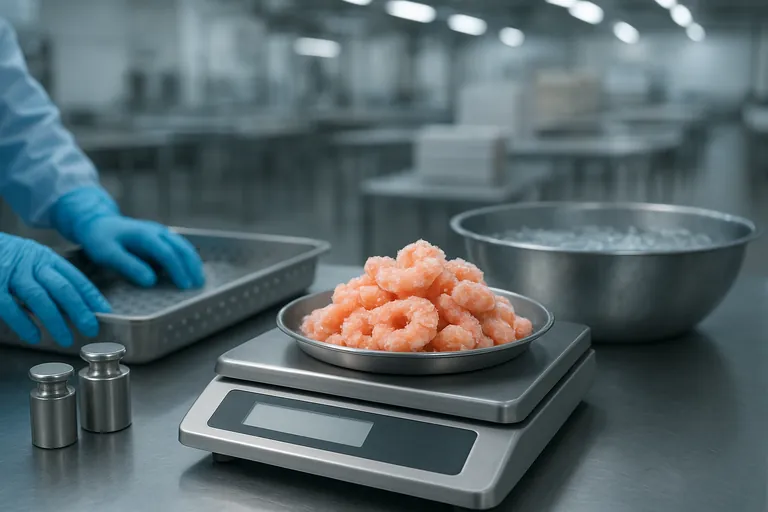
A practical, step-by-step playbook to calculate and declare “added water” on EU labels for STPP-treated shrimp. Includes calculation workflow, what to document for auditors, and exact label wording templates with quick multi-language phrases.
If you sell shrimp into the EU and use STPP, there are only two outcomes. Either your labeling and paperwork are bulletproof, or you lose margin and trust during audits. We’ve sat on both sides of the table and built a system that keeps labels clean and shipments moving.
Here’s our 2026 guide to get “added water” right under EU FIC 1169/2011 for STPP-treated Indonesian shrimp. It’s a focused, step-by-step playbook we actually use on our own lines.
The 3 pillars of EU “added water” compliance
- Product name correctness. Under FIC 1169/2011 Annex VI Part A (6), if a fishery product contains added water over 5% of the finished product, the name must state “with added water.” Shrimp falls in scope in practice when water is retained in the flesh through brining or STPP.
- Ingredient list discipline. When water is added and exceeds 5% of the finished product, declare water in the ingredients. Declare STPP as an additive with its function and name/E-number (e.g., “Stabilisers: sodium triphosphates (E451), polyphosphates (E452)”).
- Evidence you can defend. Keep a documented baseline, calculations, and lab results to prove that your added water percentage and QUID are accurate. Ice glaze is excluded from net weight and is not “added water.” Keep those two streams separate in both process and paperwork.
Week 1–2: Set your baseline (tools + templates)
Here’s the thing. Most mislabeling problems start with a lazy baseline copied from Google. In our experience, auditors challenge anything that isn’t specific to your species, size grade, and processing.
- Define the SKU. Species, size grade, form (HOSO, PD, PDTO, etc.), salt level, and whether STPP is used. Note target glaze separately.
- Build your natural moisture/protein baseline. Test 3–5 untreated batches of the same shrimp spec. We run moisture and protein using standard methods at an ISO 17025 lab. Record averages and ranges. Don’t use a fillet baseline for shrimp. Don’t use a cooked baseline for raw packs.
- Choose your calculation method. For shrimp, a protein-based approach is robust because protein is a stable marker. You’ll need your baseline protein % (P0) for untreated raw shrimp of the same spec.
Template fields to lock down:
- Species and Latin name. Example: Penaeus vannamei.
- Presentation. Example: PD, tail-on, raw, IQF.
- Baseline protein P0 (mean and range) for untreated reference.
- Additive solids planned (salt, phosphate) as % of finished product.
Practical takeaway: Your baseline is product-specific. Lock it before you print labels.
Week 3–6: Calculate and verify “added water” (and QUID)
We use a simple solids-mass logic anchored to protein. It holds up in audits and mirrors how control labs think.
Key idea. If only water is added, the protein percentage drops proportionally. So comparing measured protein to your untreated baseline shows the true shrimp fraction in the pack.
- Measure protein on the finished, deglazed, thawed, drained product (P1%).
- Use your validated baseline protein for that shrimp spec (P0%).
- Account for non-water additives that add solids (S_add%), like salt and phosphates.
Working formulae:
- Shrimp fraction in finished product ≈ P1 / P0
- Added water % ≈ 100 × [1 − (P1 / P0) − S_add]
- Shrimp QUID for label ≈ 100 × (P1 / P0)
Notes that save headaches:
-
Run a small industrial trial, not just lab beakers. Measure uptake immediately after brine/STPP, then again after 24 h equilibration and post-freeze/thaw drip. Use the stabilized value in your label math.
-
Separate glaze. Measure net weight excluding glaze for both protein testing and QUID. Glaze is protective ice, not added water.
-
Keep retailer policy in mind. Some EU retailers require displaying the % added water voluntarily even if the law doesn’t. Align early.
Practical takeaway: Don’t shortcut S_add. If you forget the salt/phosphate solids, your “added water” will be overstated.
Week 7–12: Lock the label and supporting file
By now you have stabilized uptake and a repeatable number. Turn that into clean, defensible labels.
Product name line (if >5% added water):
- English: “Shrimp with added water”
- Optional transparency if retailer requests: “Shrimp with added water (X%)”
Ingredient list structure:
- “Shrimp (Penaeus vannamei) X%, Water, Stabilisers: sodium triphosphates (E451), polyphosphates (E452), Salt”
- If you don’t want chemical names, E-numbers are acceptable with function. Example: “Stabilisers: E451, E452.”
Quick multi-language phrases for “with added water” (use native review for your exact markets):
- FR: avec eau ajoutée
- DE: mit zugesetztem Wasser
- ES: con agua añadida
- IT: con aggiunta di acqua
- NL: met toegevoegd water
- PL: z dodatkiem wody
- PT: com adição de água
Documentation pack to keep on file:
- Baseline test reports (moisture/protein) for untreated shrimp of that spec.
- Final product test reports (protein, moisture, phosphate if used), measured on deglazed, drained product.
- Process SOP for brining/STPP, target uptake, and glaze application.
- Batch records showing additive dosages, contact time, temperature, and in-process checks.
- Label artwork with product name, ingredients, net weight excluding glaze, storage, and country of origin.
If you want a sanity check on your math before print, Contact us on whatsapp. We build these calculators weekly and can turn feedback within 24–48 hours.
The 5 mistakes that kill compliance (and margins)
- Counting glaze as added water. Glaze is excluded from net weight and is not “added water.” Confusing the two wrecks both QUID and claims.
- Using a generic baseline. Protein varies by species, size grade, farming area, and season. Auditors know this. Use your own untreated reference.
- Ignoring solids from additives. Salt and phosphates add non-water mass. If you skip S_add, your “added water” will look inflated.
- Testing the wrong state. Always test the edible product as sold and consumed. Deglazed, thawed, drained. Not straight from the tunnel and not still frozen.
- Overlooking retailer overlays. Some EU buyers require “with added water (X%)” on the name line, even though the regulation doesn’t force the percentage. Align before your first print run.
Common questions we get (fast answers)
Do I have to put “with added water” on shrimp sold in the EU?
Yes, if added water retained in the shrimp exceeds 5% of the finished product. See FIC 1169/2011 Annex VI Part A (6). Below 5%, the name change isn’t triggered.
How do I calculate added water in shrimp treated with STPP?
Use a protein-anchored calculation. Added water % ≈ 100 × [1 − (P1 / P0) − S_add], where P0 is baseline protein for untreated shrimp of that spec, P1 is measured protein in the finished product, and S_add is non-water additive solids. Verify with a stabilized post-freeze/thaw test.
Does ice glaze count as added water on EU shrimp labels?
No. Glaze is external protective ice and must be excluded from net weight. Keep a separate glaze control. “Added water” concerns water retained in the flesh.
Do I need to show the percentage of added water on the label, or just the phrase?
The regulation requires the phrase “with added water” when applicable. Showing the percentage is optional unless a customer standard requires it. You must, however, list Water in the ingredients when it exceeds 5%.
How should I list STPP (E451/E452) in the ingredient list for shrimp in the EU?
Declare by function plus name or E-number. For example: “Stabilisers: sodium triphosphates (E451), polyphosphates (E452)” or “Stabilisers: E451, E452.”
What moisture baseline should I use to prove water was added to shrimp?
Your own untreated baseline for that exact SKU. Same species, size grade, and processing form. We prefer protein baselines because they’re less sensitive to small water handling differences and align with how labs evaluate added water.
If added water is under 5%, do I still need to change the product name?
No. The “with added water” phrase is triggered above 5%. Depending on total water added, you may still need to list Water in the ingredients if it’s >5% of the finished product.
When this advice applies (and when it doesn’t)
This playbook applies to raw, frozen, deglazed shrimp sold in the EU, including STPP-treated PD/PDTO/HLSO formats. If you sell cooked shrimp, marinated products, or ready-to-eat packs, you’ll need a slightly different baseline and QUID logic because cooking alters solids and moisture. Also, EU additive permissions and maximum levels are controlled under separate EU additive rules. This guide focuses on labeling and the “added water” trigger under FIC 1169/2011.
What’s interesting is how much smoother EU audits run when we keep glaze, added water, and QUID on separate lines in the spec. It shortens reviews and avoids rework.
Resources and next steps
- Need a compliant, phosphate-managed shrimp spec with transparent labeling? We ship EU-ready Frozen Shrimp (Black Tiger, Vannamei & Wild Caught) with either STPP-free processing or validated “added water” declarations.
- Have a retailer asking for percentage-on-name or a stricter threshold? Send us your baseline and last lab sheet and we’ll run a quick gap check. Questions about your project? Call us.
We recommend you bookmark this guide and adapt the formulas to your own spec sheet. Three out of five new customers we meet are tripped up by generic baselines or by mixing glaze into the math. Put the right numbers in the right places, and EU labeling becomes predictable.