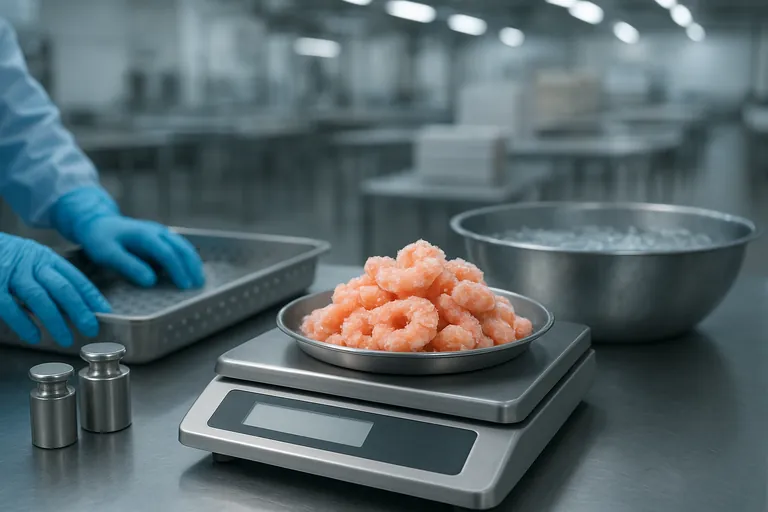
A practical, step-by-step method to standardize Indonesian squid and cuttlefish FOB quotes to a net-of-glaze, edible-yield basis so you can compare suppliers fairly. Includes exact formulas, quick-reference factors for 10/20/30% glaze, and worked examples across formats (whole round, cleaned tubes, rings; IQF vs block; common size grades).
If you’ve ever tried to compare squid and cuttlefish quotes from three Indonesian suppliers and ended up with five different answers, you’re not alone. We’ve seen buyers cut 8–12% from their squid spend in one quarter using this exact comparison method. The trick is simple. Normalize every quote to a net-of-glaze, edible-yield basis. Then compare apples to apples.
We’re the Indonesia-Seafood Team, and this is the system we use daily when buyers send us mixed quotes for whole round, cleaned tubes, and rings. No forecasts, no freight. Just the math you need to make a clean decision.
The 3 pillars of fair price comparison
-
Standardize the weight basis to net-of-glaze (NW). Most confusion starts with glaze. One supplier quotes per glazed weight (GW) at 20% glaze, another per net weight (NW), and a third per carton. Convert all to price per kg NW first.
-
Standardize to an edible-yield cost. Once everything is net-of-glaze, account for yield differences between whole round (WR), whole cleaned (WC), tubes, rings, or fillets. Your decision should be on cost per edible kg, not just cost per purchased kg.
-
Standardize specification and port. Align IQF vs block, size grade bands (U5, U7, U10), trim level, and glaze tolerance. Confirm the same FOB port, typically Surabaya or Jakarta. Then compare.
Here’s the thing. When you apply these three pillars consistently, the “cheapest” quote often isn’t the cheapest on the plate.
Weeks 1–2: Quote audit and set-up (tools + templates)
Start by normalizing weight statements and glaze.
What’s the difference between NW, GW, and glazed weight on Indonesian seafood quotes?
- NW (net weight): product weight without glaze.
- GW (glazed weight): product plus protective ice glaze.
- Carton weight: may be stated as NW or GW. Always confirm which one.
Quick relationship: GW = NW / (1 – glaze%). And NW = GW × (1 – glaze%).
How do I remove 20% glaze to compare squid FOB prices fairly?
If the quote is priced per kg of GW and glaze is 20%, convert to net-of-glaze price:
Price per kg NW = Price per kg GW ÷ (1 – 0.20) = Price per kg GW ÷ 0.80.
At 20% glaze, multiply by 1.25. Example: 3.80 $/kg GW becomes 4.75 $/kg NW.
What’s the formula to convert an Indonesian FOB quote to net weight pricing?
Use one of these depending on how the quote is written:
- Price is per kg GW: Price_NW = Price_GW ÷ (1 – glaze%).
- Price is per carton (with NW stated): Price_NW = Carton_Price ÷ Carton_NW.
- Price is per carton (with GW stated): Price_NW = Carton_Price ÷ [Carton_GW × (1 – glaze%)].
Then convert to edible-yield cost:
Edible cost per kg = Price_NW ÷ edible_yield%.
Note: For already-edible items like cleaned tubes or rings, edible_yield% is often 1.00 minus expected drip/trim. We use 0.97–0.99 for IQF tubes depending on supplier and thaw protocol.
Is there a standard glaze percentage for IQF squid and cuttlefish from Indonesia in 2025?
Recent programs we run are:
- Retail or private label: 10% glaze becoming more common.
- Foodservice and bulk IQF: 20% is still the default.
- Some commodity rings and tentacles: 20–30% (check tolerance and audit methods).
- Block frozen: 0–10% glaze, often minimal.
Quick-reference factors to strip glaze to net:
- 10% glaze: divide by 0.90 (×1.111).
- 20% glaze: divide by 0.80 (×1.25).
- 30% glaze: divide by 0.70 (×1.429).
How do size grades (U5, U7, U10) affect net price per edible yield?
Larger sizes generally command higher FOB because of scarcity and better plate presentation, but they can also carry slightly better edible yields. Our rule of thumb from recent QC:
- Each step up in size grade may improve edible yield by 2–4 points on tubes and cuttlefish portions due to lower trim ratio and less breakage.
- Price lifts between grade bands often fall in the 5–15% range, supplier and season dependent.
Always plug your own verified yields into the edible-cost formula. Two points of yield swing can erase a nice-looking headline price.
FOB Surabaya vs FOB Jakarta: does it matter?
For normalization, pick one. We benchmark to FOB Surabaya for most squid and cuttlefish because many IQF plants and cold stores serving East Java landings are there. Jakarta quotes sometimes carry a small delta that’s logistics related. If you get mixed ports, ask vendors to restate as FOB Surabaya or note the delta separately before comparing.
Weeks 3–6: Test the method on real quotes (worked examples)
We’ll use simple, realistic examples. Numbers are illustrative.
Example A. IQF Loligo cleaned tubes at 20% glaze
- Quote: 3.80 $/kg GW, IQF, 20% glaze, FOB Surabaya, size U10.
- Net-of-glaze price: 3.80 ÷ 0.80 = 4.75 $/kg NW.
- Expected drip on proper thaw: 2%. Edible cost: 4.75 ÷ 0.98 = 4.85 $/kg edible.
Example B. Block frozen whole round squid vs IQF whole cleaned
- WR quote: 2.90 $/kg block, 0% glaze. To turn into tubes and tentacles you estimate 65% edible yield with your line. Edible cost: 2.90 ÷ 0.65 = 4.46 $/kg edible.
- WC IQF quote: 4.10 $/kg GW at 10% glaze. Net-of-glaze: 4.10 ÷ 0.90 = 4.56 $/kg NW. Drip at 2% gives edible cost 4.56 ÷ 0.98 = 4.65 $/kg.
- Decision: WR looks slightly cheaper on edible basis, but you’ll carry processing labor, variability, and reject risk. If labor is tight or spec consistency matters, WC may be the better total-cost choice.
Example C. Cuttlefish whole round U5 vs cleaned fillets U7
- WR quote: 5.50 $/kg GW at 10% glaze. Net-of-glaze: 5.50 ÷ 0.90 = 6.11 $/kg NW. Your verified edible yield to cleaned fillet is 55%. Edible cost: 6.11 ÷ 0.55 = 11.11 $/kg edible.
- Cleaned fillets quote: 7.90 $/kg GW at 20% glaze. Net-of-glaze: 7.90 ÷ 0.80 = 9.88 $/kg NW. Thaw drip 2%. Edible cost: 9.88 ÷ 0.98 = 10.08 $/kg edible.
- Decision: Despite the higher headline price, the cleaned fillets are cheaper per edible kg and carry less processing risk.
Example D. Rings vs tubes from the same IQF tubes
- Tubes: 4.75 $/kg NW (from Example A). Converting to rings costs 0.30 $/kg labor and trims 5% in your plant. Edible cost of rings: (4.75 + 0.30) ÷ 0.95 = 5.32 $/kg.
- Direct rings quote: 5.25 $/kg GW at 20% glaze. Net-of-glaze: 5.25 ÷ 0.80 = 6.56 $/kg NW. If your spec needs tight ring widths or zero membrane, supplier-made rings may justify the lift. Otherwise, in-house rings win.
Takeaway: Always move quotes to price per kg NW. Then convert to edible cost using your yields. The cheapest headline rarely wins once you normalize.
If you want our one-tab calculator that does these steps with dropdowns for 10/20/30% glaze and common size grades, just ask and we’ll share it. Need a quick review of your current quotes? You can Contact us on whatsapp.
Weeks 7–12: Scale and optimize your program
- Lock glaze tolerance and audit method. State glaze as 10% or 20% with ±2% tolerance and define the thaw and drain procedure. In our experience, ambiguity here costs real money.
- Specify size-grade mapping. For mixed quotes, align U5/U7/U10 or exact cm length bands for Loligo Squid (Whole Round / Whole Cleaned). Larger grades often carry better cook yield and less breakage. Capture that in your edible-yield assumption by grade.
- Align pack format. IQF vs block. IQF typically carries more glaze and handling value. Block often wins on unit price but may lose on labor and wastage. Benchmark both on the same edible-cost basis.
- Add drip verification. We recommend monthly QC where two cartons per lot are thawed under your SOP and netted back to edible weight. Adjust the spreadsheet’s drip factor with live data.
- Keep port consistent. We standardize to FOB Surabaya unless a program genuinely ships from Jakarta. If a quote feels “off,” ask the plant for their nearest FOB port and internal trucking costs.
The 5 biggest mistakes we see (and how to avoid them)
- Comparing GW to NW. Always convert to net-of-glaze first. A 20% glaze quote looks 25% cheaper on paper if you don’t strip it.
- Ignoring edible yield. WR to WC to rings can swing 10–20 points in yield. Your cost per edible kg is what hits your P&L.
- Overlooking drip. IQF tubes that thaw at 97–98% don’t cost the same as those at 94–95%. Build this into your model.
- Mixing ports and formats. FOB Jakarta IQF vs FOB Surabaya block will skew your baseline. Pick one benchmark.
- Taking size-grade deltas at face value. U5 vs U7 isn’t just price. Yield and breakage vary. Verify with a small test lot before committing volume.
Resources and next steps
Copy-paste formulas for your sheet:
- Price_NW from GW: Price_GW ÷ (1 – glaze%).
- Price_NW from carton GW: Carton_Price ÷ [Carton_GW × (1 – glaze%)].
- Price_NW from carton NW: Carton_Price ÷ Carton_NW.
- Edible cost per kg: Price_NW ÷ edible_yield% (or Price_NW ÷ [1 – drip%] for ready-to-cook items).
Typical edible-yield starting points to validate on your line:
- Squid whole round to tubes + tentacles: 60–70%.
- Squid tubes to rings (tight spec): 90–95%.
- Cuttlefish whole round to cleaned fillet: 50–60%.
- Ready-to-cook IQF tubes/rings drip: 1–3% with controlled thaw.
Want to see standard Indonesian specs for reference while you build your model? Check our Loligo Squid (Whole Round / Whole Cleaned), and if you’re planning a broader assortment, you can also View our products to align case weights and packing across species for simpler consolidations.
Questions about your specific yields or a mixed IQF vs block decision? We’re happy to sanity-check your sheet and send a sample SOP for glaze verification. Contact us on whatsapp and mention “FOB normalization” so it gets to the right person.
In our experience, once you normalize to net-of-glaze and edible yield, the “right” supplier becomes obvious. And that’s when pricing discussions start to move your way.