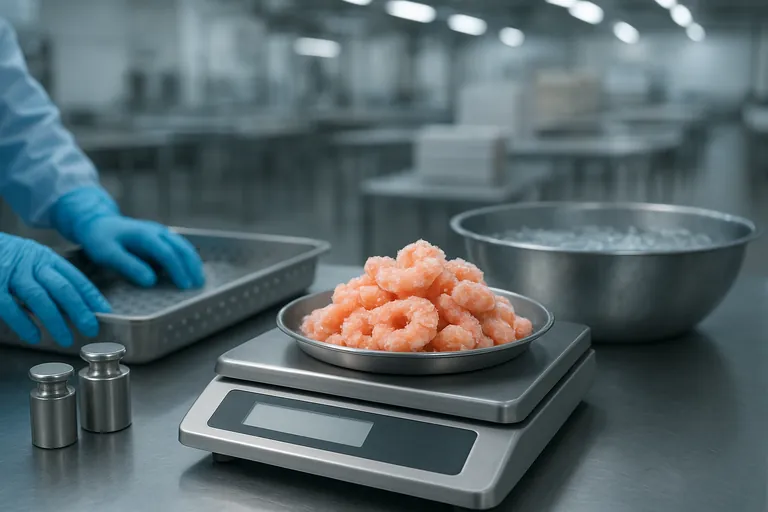
A receiver-side, step-by-step deglazing SOP for Indonesian frozen shrimp. Exact water temperatures, rinse times, sampling plan, tolerances, and a simple calculation you can run at the dock—aligned with common buyer specs and NIST Handbook 133 practice.
If you’ve ever argued about “short weight” on shrimp, you know how quickly trust evaporates. We’ve cut claims to near-zero in 90 days at several buyer sites by standardizing one thing: a simple, repeatable deglazing procedure at receiving that everyone can agree on. In this guide, we share the exact steps, temperatures, times, sampling plan, tolerances, and calculations we use for Indonesian frozen shrimp. It’s grounded in current NIST Handbook 133 practice and consistent with OIML R 87 net contents rules used in many markets.
Why glaze exists, and what’s a fair percentage in 2026
Glaze is a food-safe ice coating that protects shrimp from dehydration and oxidation during storage. Without it, you’ll see freezer burn and color loss fast. The reality is, buyers don’t want to pay for water. And processors want the product to arrive in spec. A fair balance has emerged in the market:
- Retail and foodservice packs: 6–12% protective glaze on IQF raw shrimp is common and fair when cold-chain is strong.
- Longer distribution or display: up to 15–20% may be justified, but it should be declared, and the net weight must exclude glaze.
In our experience, Indonesian producers who target 8–12% glaze on IQF Vannamei or Black Tiger have the fewest disputes. That’s also the ballpark most auditors accept when net weight is properly verified.
If you need shrimp targeted to your exact glaze spec, we can do that on our Frozen Shrimp (Black Tiger, Vannamei & Wild Caught) line, and we use the same rigor on our IQF finfish like Grouper Fillet (IQF).
The receiver-side deglazing SOP we recommend
This is the “ice glaze removal test” we align with NIST Handbook 133 seafood procedures. It’s designed to verify true net weight without cooking or waterlogging the shrimp.
- Condition the sample
- Keep product at receiving temperature. Don’t let it partially thaw in ambient air. Document case temp on arrival.
- Select your sample (see sampling plan below)
- Record lot number, count size, pack weight, and time.
- Prepare gear
- Calibrated scale with 1 g readability for packs up to 1 kg. 2–5 g readability is fine for bulk totes. Verify with a check weight daily.
- Stainless colander or perforated pan. Timer. Thermometer. Clean tray and absorbent paper.
- Weigh the unopened package
- Record gross package weight.
- Determine tare
- Remove shrimp block or IQF contents. Wipe any free ice flakes from the inside of the bag, then weigh empty packaging. Record tare.
- Weigh frozen product before deglaze (Wf)
- Product only. No packaging, no free loose ice that isn’t adhering to the shrimp.
- Deglazing procedure
- Water temperature: 10–21°C. We aim for 12–15°C. Colder than 10°C makes glaze removal slow; warmer than 21°C risks surface protein denaturation.
- Flow: Gentle running water. Avoid high-pressure jets that can knock off tissue.
- Rinse time: 30–90 seconds for IQF. Up to 2 minutes for heavy blocks. Stop as soon as visible glaze is gone and surfaces feel slightly tacky, not slick.
- Agitation: Light hand-toss in the colander every 10–15 seconds. No squeezing.
- Drain and surface-dry
- Drain in the colander for 2 minutes at a slight tilt. Then lay the shrimp on a clean tray lined with a single layer of absorbent paper for 30 seconds. Do not pat or press.
- Weigh deglazed product (Wd)
- Record immediately after drain and 30-second surface rest.
- Calculations
- Glaze percentage = [(Wf − Wd) ÷ Wf] × 100
- True net weight per pack = Wd
- Compare average Wd of your sample to declared net weight.
Takeaway: Consistency beats precision gadgets. If you control water temperature, rinse time, and drain time, you’ll get repeatable readings that hold up in a dispute.
Sampling plan that holds up in audits
You don’t need to open half the truck. But you do need enough units to make a defensible decision.
- Retail packs (≤1 kg): Take 12 packages per lot code. Pull across at least 3 different master cases and two layers within each case.
- Foodservice bags (1–2 kg): Take 8–12 packs depending on lot size. If the lot exceeds 800 cartons, go to 12.
- Bulk IQF in cartons: Aggregate sample of 2–3 kg, taken from 5 or more cartons scattered across the load.
Why 12? It aligns with common acceptance sampling in net contents control. Most regulators accept a 12-unit sample if the average meets or exceeds the declared net weight and no unit is below the tolerable negative error by more than the allowed limit.
What tolerance is acceptable before rejection?
Two rules dominate global practice.
- Average requirement: The average net weight of the sample can’t be less than the declared net weight.
- Individual package limit: A single package can be short as long as it doesn’t exceed the allowable underweight (MAV/TNE) and not too many are short.
Typical allowable underweight (check your market):
- Around 9 g for a 500 g declared weight.
- Around 15 g for a 1 kg declared weight. These tolerances mirror OIML R 87 TNE and are similar to the MAV tables used with NIST Handbook 133 in the U.S. Always apply your receiving country’s table during decisions. Our internal rule for import shrimp QC is simple: if the sample average is below declared, we hold. If two or more units exceed the single-unit TNE, we hold.
Tools: Can you do this with a kitchen colander and a handheld scale?
Yes, and many receivers do. A few non-obvious tips:
- Scale: 1 g readability up to 2 kg. Check with a certified weight or a known 1,000 g reference daily. Level the scale.
- Thermometer: Spot-check rinse water every run. Don’t trust “cold tap” by feel.
- Timer: Use it. Rinse and drain times drift when teams get busy.
- Colander: Stainless with uniform perforations. Plastic can retain heat and flex.
Why does net weight drop after thawing, even when glaze looks right?
We see three culprits:
- Drip loss. Shrimp lose bound water as they thaw. Fast thaw in cool water followed by a short drain helps, but some drip is inevitable.
- Overlong rinse. If you rinse for 3–4 minutes or use warm water, you’ll strip surface proteins and lose weight.
- Partial thaw before testing. If the shrimp sat warm during paperwork, you’re measuring additional purge, not just deglaze.
Pro tip: Keep total test time under 15 minutes from opening the case to final weigh.
Quick answers to the questions we hear most
What’s a fair glaze percentage for Indonesian frozen shrimp?
We recommend 6–12% for IQF raw shrimp in standard distribution. Up to 15–20% can be fair for long holds or retail display, but declare it clearly and always verify net weight excluding glaze.
How do I deglaze shrimp to check true net weight without cooking it?
Use 10–21°C water, gentle flow, 30–90 seconds for IQF. Drain 2 minutes, rest 30 seconds on a single sheet of paper, then weigh. This mirrors NIST Handbook 133 seafood practice for deglazing procedure.
What water temperature and rinse time should I use?
Target 12–15°C for control and speed. Cap total rinse at 2 minutes. Stop as soon as the slick glaze is gone and surfaces feel slightly tacky.
How many retail packs should I sample per lot to be confident?
Twelve. Pull from multiple master cases and layers. It’s the sweet spot between statistical confidence and practicality.
What net weight tolerance is acceptable before I reject a shipment?
Your sample average must meet or exceed declared net weight. For individual packs, use your market’s MAV/TNE table. As a rule of thumb: about 9 g for a 500 g pack and 15 g for a 1 kg pack. If in doubt, hold and escalate.
Can I do the test with only a kitchen colander and a calibrated scale?
Yes. Many facilities do. The discipline is in temperatures and timers, not fancy gear.
Why does net weight drop after thawing even when glaze looks correct?
Likely drip loss or a warm, overlong rinse. Keep water cool, keep times short, and don’t let the sample warm up while you prep.
Common mistakes that create “short weight” drama
- Rinsing with warm water “to go faster.” You’ll introduce cooked edges and extra drip.
- Not weighing packaging tare. A wet bag can add several grams and skew results.
- Mixing sample units across different lot codes. Keep samples lot-true.
- Aggressive pat-drying. Pressing with towels can remove surface moisture beyond glaze.
- Using the wrong comparison. Always compare Wd to the declared net weight, not to the pre-deglaze number.
A simple, auditable record that ends arguments
At receiving, one page should capture: lot code, case temperature, sample selection map, Wf and Wd for each unit, water temperature, rinse and drain times, scale ID, operator initials, and calculations for average net and glaze percent. When a dispute comes up, that single sheet plus two photos of the process usually ends it in minutes. If you’d like our deglazing record sheet template, Contact us on whatsapp and we’ll share a fillable PDF.
Final takeaways you can use today
- Set your rinse to 12–15°C and cap total rinse at 2 minutes. Drain 2 minutes. Rest 30 seconds. Then weigh.
- Sample 12 packs per lot. Compare average net to the label, and apply your market’s single-unit tolerance.
- Keep a tight, photo-documented record. It’s your best defense and the fastest way to fix real issues with partners.
If you want shrimp that land consistently within a 6–12% glaze target and clear net weight records, start with product built for that outcome. Explore our Indonesian lineup here: View our products.