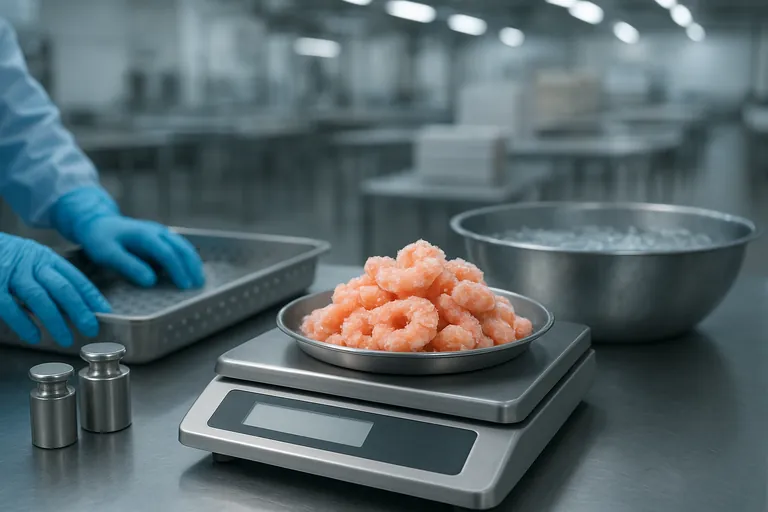
A practical, plant-floor SOP for screening sulfites in shrimp with 10–15 minute rapid kits. Clear pass/fail triggers for EU/US/JP, step-by-step sample prep, avoiding interferences, reading mg/kg (ppm), and what to do if a lot fails.
If you process or buy shrimp in 2026, you can’t afford guesswork on sulfites. We’ve seen good lots rejected because the in-plant screen was sloppy or misread. The flip side is better: a tight, simple rapid test SOP that gives you a 10–15 minute answer you can trust, aligned to your buyers’ limits. Here’s the exact approach we use across Indonesia-Seafood when we screen export shrimp, with the pitfalls we learned to avoid.
What counts as a pass or fail in 2026?
Short answer. Work to the strictest buyer requirement your lot will face. Regulations set guardrails, but programs and retailers often tighten them.
- EU. The long-standing limit for crustaceans is commonly applied at 150 mg/kg as SO2 at sale. Many EU retailers still specify ≤100 mg/kg to keep safety margin against lab variance. Always confirm current EU additives tables before shipment.
- US. Labeling is required if sulfites are present at ≥10 mg/kg (ppm). There isn’t a single national MRL like the EU, but most importers set internal limits. We see ≤100 mg/kg frequently, and some buyers demand “no added sulfite” programs that effectively require <10 mg/kg.
- Japan. Importers often target ≤100 mg/kg, but premium programs expect non-sulfited shrimp and screen for <10 mg/kg. Check each PO/spec.
- Indonesia (BPOM). Exporters must meet destination market limits. BPOM guidance is aligned with Codex and requires correct additive use and labeling. Verify current PerBPOM additive/use and labeling requirements before domestic sale or export.
Our practical rule. If you want flexibility to sell into EU/US retail programs, screen to ≤100 mg/kg. For “no sulfite added” claims or Japan premium specs, target <10 mg/kg.
Takeaway. Define pass/fail per PO before you test. If your spec is ≤100 mg/kg, treat 80–120 mg/kg as a grey zone and confirm via a reference lab before release.
Which rapid sulfite kits work for shrimp?
You’ll see three useful formats on the plant floor:
- Colorimetric strip kits with acid extraction. Low cost and quick. Ranges often cover about 10–200 mg/kg with extensions up to ~400 mg/kg by dilution. Good for routine pass/fail.
- Portable photometer kits. Same chemistry as strips but with a handheld reader. Better precision around decision points such as 80–120 mg/kg.
- Microdiffusion-style rapid kits. Closer to reference chemistry but slower and a bit fiddlier. Helpful for borderline lots.
In our experience, the best kits include an acid liberator to convert bound sulfite to SO2, a defined extraction volume, and a readable scale or meter output. We avoid “dips-only” methods meant for liquids unless they provide a clear solid-sample protocol and dilution math.
If you need a reference result for certification or dispute, send a sample to a lab for Monier-Williams (AOAC Official 990.28) or a validated equivalent. We routinely correlate our in-plant screens against Monier-Williams to keep our bias in check.
How to prepare shrimp samples so the result is real
Here’s the step-by-step prep we standardize across plants. It’s simple, but every detail matters.
-
Define your test basis. Decide if you’re screening peeled/deveined meat or whole. Buyers care about what the consumer eats, so we test edible muscle. Remove shell and gut if not part of the finished product.
-
Control thaw and glaze. Thaw under flowing potable water or chilled air to 0–2°C core. Remove 100% of the ice glaze. Blot gently to surface-dry. We test the glaze water separately if we suspect treated glaze.
-
Homogenize properly. Coarse-chop 10–20 pieces across the lot’s weight grades. Use a sanitized grinder or blender. Aim for a uniform paste. Take 10.0 g composite into a labeled tube.
-
Extract with the kit buffer. Add the specified volume, often 90 mL. The acid liberates SO2 from bisulfite and weakly bound forms. Mix vigorously for 1–2 minutes. Let solids settle.
-
Measure promptly. Follow the kit timing strictly. Read strips at the exact time window or record the photometer value.
-
Run QC alongside. Always run a reagent blank and a spiked recovery once per shift. For spike, add a known sulfite standard to a negative matrix and confirm recovery between 80–110%.
Non-obvious but critical:
- pH matters. Your extract should be at the kit’s target pH so bound sulfites are released. If the color seems off or slow, check pH with a pocket meter and adjust per kit instructions.
- Antioxidants interfere. Ascorbic acid can skew iodine-based chemistries. Choose kits that account for it or use the provided pre-treatment.
- Gloves and tools. Use nitrile gloves and acid-safe tools. We’ve traced false highs to shared brine buckets and cutting boards.
How many units per lot should you test?
We balance risk and speed. Here’s a practical sampling plan that’s worked for us across shrimp packs 1–20 MT:
- Draw 5 primary samples per lot up to 5 MT. Add 1 more primary per additional 2 MT, capped at 10 primaries.
- Each primary is a composite of 10 units pulled across pallet tiers, outer and inner cartons, and the smallest sales unit. Mix sizes if the lot is mixed.
- From each primary composite, run one rapid test. If any result is >80 mg/kg when your spec is 100 mg/kg, duplicate that primary and test a second aliquot. If a duplicate confirms >100 mg/kg, escalate to hold-and-test.
If your customer spec is <10 mg/kg (no added sulfite), screen primaries in duplicate. One detected result triggers escalation.
Takeaway. More small composites beat one giant composite. You learn about variability and catch pockets early.
Why do results drift after thawing?
We get this question weekly. Three reasons drive the increase you sometimes see:
- Moisture shifts. As product thaws and drip loss occurs, the same sulfite mass sits in less water. Concentration goes up.
- Bound-to-free changes. Acidic or enzymatic conditions during thaw can release more free SO2, which many rapid kits detect more readily.
- Glaze confounding. If glaze carried sulfite, removing it will change the mass basis unless you standardize the state you test.
Control it by testing at a consistent state. Fully deglazed, well-blotted, and 0–2°C. If you must compare to a lab’s Monier-Williams on frozen product, match their prep state or you’ll argue over numbers rather than quality.
Converting kit readings to mg/kg (ppm)
Most kits read the liquid extract in mg/L as SO2. The conversion is simple if your weights and volumes are consistent.
Example.
- 10.0 g shrimp + 90 mL extraction buffer gives ~100 mL final volume.
- Suppose the strip/photometer reads 12 mg/L SO2 in the extract.
- Total SO2 in the tube ≈ 12 mg/L × 0.100 L = 1.2 mg SO2.
- Per kg of shrimp: 1.2 mg ÷ 0.010 kg = 120 mg/kg, which equals 120 ppm.
Write the math on your worksheet. We include the sample weight, final volume, extract reading, and the calculated mg/kg on the COA so buyers can follow the logic.
How to reduce false positives and negatives
- Always run a matrix blank. Use shrimp known to be sulfite-free as your negative control. Keep a frozen control batch.
- Test the water. Check process water and glaze water for sulfite. We’ve traced surprising highs to reused dip solutions.
- Respect timing windows. Most strips change color over time. Read at the specified minute.
- Calibrate photometers weekly. Record with a simple log. Small drift near 100 mg/kg is costly.
What to do if a lot fails your screen
Don’t panic. Do this in sequence.
- Quarantine the lot. Identify pallets and lock them in WMS/ERP.
- Re-test. Duplicate the failing primary, plus an adjacent primary. Confirm with fresh prep.
- Send to lab. If still failing or borderline (80–120 mg/kg for a 100 mg/kg spec), courier a sealed sample for Monier-Williams.
- Root cause. Check dip concentration logs, contact time, reuse cycles, and whether thaw/glaze procedures deviated. We often find an over-concentrated metabisulfite dip or prolonged soak in reworked batches.
- Decide. If MW confirms pass under your spec, release with COA. If not, consider rework if allowed by your buyer, or divert to a market with compatible limits after transparent disclosure.
Pro tip. Add a pre-freeze screen right after processing. Catching issues before freezing saves days.
A simple in-plant SOP you can start tomorrow
- Define your buyer spec per market and build decision limits (Pass, Grey, Fail).
- Sample 5–10 primaries per lot as above. Prep consistently. Use acid-based extraction kits.
- Convert to mg/kg with written math. Record blanks and spikes.
- Escalate grey-zone results for lab confirmation before release.
If you’d like our one-page worksheet and calibration log, or want us to pre-screen export lots of Frozen Shrimp (Black Tiger, Vannamei & Wild Caught) to your buyer’s thresholds, just Contact us on whatsapp. We’ll tailor the sampling plan and cut your false rejects.
Final notes on compliance in 2026
- Enforcement is getting tighter. EU and major retailers are increasing verification testing under updated official controls and supplier assurance. Expect more spot checks, not fewer.
- Keep correlation current. We recheck our rapid kit bias against Monier-Williams at least quarterly per plant. It’s cheap insurance.
- Document like a lab. Clear worksheets, reagent lot numbers, and photos of strip readings near decision points go a long way when there’s a question from a buyer.
We’ve found that consistency beats sophistication. A humble strip kit, a good homogenizer, and disciplined sampling will protect your brand and your margins. And when you need sashimi-grade tuna or whitefish alongside shrimp, you can still rely on the same rigor across our range. You can also View our products if you’re building multi-spec procurement programs.
As always, confirm the latest EU/US/JP/BPOM rules before finalizing specs. And if a buyer wants you to hit <10 mg/kg, that’s doable. You’ll need tight control on dips and processing flow, and you’ll need to test every lot. That’s where a solid, 10-minute screen pays for itself.