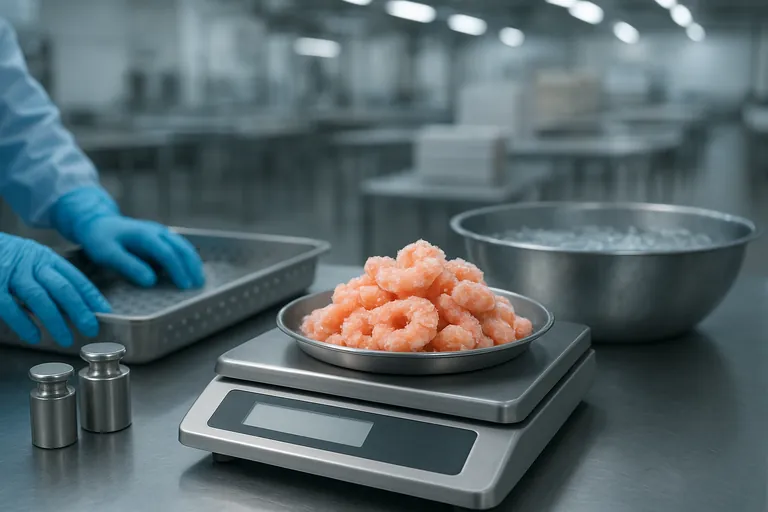
A field-friendly, step-by-step method to screen shrimp for added STPP at receiving. Includes which Hach range to use, how to prep samples, convert results to P2O5 for EU/US specs, and how to avoid common testing pitfalls.
If you manage receiving QC, you don’t have time for lab-only methods. You need a fast, defensible way to screen shrimp for added STPP and decide what to do with the truck in front of you. Here’s the exact on-site approach we use and recommend to buyers worldwide in 2025.
Why STPP testing matters in 2025
Polyphosphate use in shrimp isn’t new, but scrutiny is. EU buyers are increasingly asking for results expressed as P2O5 and checking that added levels stay within typical buyer specs around 0.5% P2O5 (5 g/kg). US buyers lean on “no added phosphate” claims and sensory checks, but more are asking for rapid field screening. We’ve seen more spot audits since mid‑2024 focusing on water addition and labeling accuracy. If you can verify STPP status at receiving, you reduce disputes, rework and brand risk.
Quick answer: How to test shrimp for STPP at receiving without a lab
- Use a common phosphate test kit with an ascorbic‑acid (molybdenum blue) method. Hach’s PhosVer 3 is a reliable choice.
- Do a simple acidic water extract of a composite shrimp sample. Measure orthophosphate in the extract. Convert to % P2O5 on shrimp.
- Compare the result to your market spec. For EU-oriented programs, many buyers cap added P2O5 around 0.5% (confirm your customer’s limit and claim).
In my experience, if your calculated P2O5 is below 0.2%, product is typically untreated. Between 0.2–0.5% is borderline or lightly treated. Above 0.5% suggests definite addition and needs label alignment or corrective action.
Step-by-step: On-site shrimp phosphate test (field method)
This is the method we use for receiving QC. It’s field-friendly and pairs well with Hach kits.
- Sampling and prep
- Pull a truly representative composite. For each lot, take 8–10 pieces across cartons and layers. If the lot is large or mixed, increase sampling.
- Deglaze. Rinse off surface ice quickly with deionized water and blot dry. Surface glaze can carry phosphate and inflate readings.
- Mince. Combine enough pieces to get 10 g of shrimp meat (no shell) and chop finely for consistency.
- Extraction
- Add 10 g minced shrimp into a clean jar.
- Add 100 mL deionized water and 1 mL of 1 N HCl. Target pH ≈ 2–3. Acid helps hydrolyze polyphosphate to orthophosphate so the kit can detect it.
- Shake vigorously for 2 minutes. Let stand 10–15 minutes. Shake again briefly.
- Filter or decant the clear supernatant through a coffee filter or syringe filter. This is your test solution.
- Measurement (Hach kit)
- Use the ascorbic acid method with PhosVer 3 reagent. Choose range based on expected concentration.
- Which range? If you’re screening for added STPP, your undiluted extract will often be too high for LR. We prefer HR because it reduces the number of dilutions.
- LR works if you’re comfortable doing 1:50–1:200 dilutions. HR lets many teams stay within 1:10–1:50.
- Record the instrument’s reporting basis. Hach meters can display results as P (PO4‑P), as PO4, or as P2O5. Note exactly which unit you used.
- Dilution
- Always do a quick small‑scale trial. If your first reading pegs the high end, dilute the extract with deionized water. Record the dilution factor.
- Calculate % P2O5 on shrimp
- If your result is reported as P (mg/L PO4‑P):
- mg P2O5 in extract = mg/L P × extract volume (L) × 2.29
- If your result is reported as PO4 (mg/L):
- mg P2O5 in extract = mg/L PO4 × extract volume (L) × 0.747
- Then convert to % on shrimp: % P2O5 = [mg P2O5 in extract / (shrimp mass in g)] / 10
Example: You used the P basis.
- 10 g shrimp. 100 mL extract (0.1 L). You read 150 mg/L as P (after accounting for any dilution).
- mg P2O5 = 150 × 0.1 × 2.29 = 34.35 mg
- % P2O5 on shrimp = 34.35 / (10 × 10) = 0.3435% P2O5
Practical takeaways:
- Use HR where possible to minimize dilutions.
- Keep your extraction ratio consistent so results are comparable lot to lot.
- Always note the reporting basis (P vs PO4). Most misinterpretations we see come from mixing units.
Which phosphate test kit range works best for shrimp (LR vs HR)?
Here’s what’s worked consistently for receiving teams:
- HR range for screening STPP-treated shrimp. Your extract can easily correspond to tens or hundreds of mg/L on a P basis before dilution.
- LR range for untreated claims or if you plan a larger dilution. LR is very sensitive but requires careful pipetting when you’re aiming for a narrow window.
- We recommend a Hach spectro or colorimeter with PhosVer 3 and HR-compatible reagents for repeatability. Cheap aquarium strips work in a pinch but aren’t defensible in a dispute.
Can glazing and ice melt skew phosphate readings on shrimp?
Yes. Two common pitfalls:
- Surface glaze can contain phosphate if the product was dipped or sprayed post-treatment. If you don’t deglaze and blot, you’ll overestimate.
- Meltwater in a thawing bag concentrates phosphate as water evaporates. Never test meltwater alone. Always test a controlled extract from minced meat.
Deglaze, blot, then mince before extraction. It’s the simplest way to keep numbers honest.
What phosphate result suggests added STPP versus natural levels?
Our rule of thumb from hundreds of lots:
- <0.20% P2O5. Typically untreated. Corroborate with taste/texture.
- 0.20–0.50% P2O5. Borderline or light processing. Verify COA and label claims. Some natural variability exists across species and feeds, but this range deserves a second look.
-
0.50% P2O5. Strong indication of added polyphosphate. Align label and spec or take corrective action.
For EU buyers, many use 0.5% P2O5 as a working maximum for added phosphate in crustaceans. Always confirm your customer’s exact limit and claim language.
How do I convert a phosphate test result to P2O5 to check EU limits?
- If result is mg/L as P: multiply by 2.29 to get mg/L as P2O5.
- If result is mg/L as PO4: multiply by 0.747 to get mg/L as P2O5.
- Then scale to your extraction and sample weight with the formula above to get % P2O5 on product.
Tip: Build a simple spreadsheet so your team can input sample weight, extract volume, instrument units and dilution factor. If you want our template, reach out and we’ll share it.
How many samples per lot should I test to screen for STPP in shrimp?
For routine receiving QC:
- Minimum: 5 composites per lot up to 10 MT, each composite made from 8–10 pieces across cartons.
- Larger or mixed lots: 1 composite per 2 MT. If any composite is borderline (>0.4% P2O5), test the sub-samples individually.
- Record carton IDs and temperatures. If you discover a hot spot, you can segregate rather than reject the whole lot.
Verify supplier COA and labeling
We’ve seen COAs list “phosphate as P2O5 ≤ 0.5%” while labeling says “no added phosphates.” That’s a mismatch. If your test shows >0.2% and the label claims “no added,” ask for batch processing records and revise claims before shipment clears. For Indonesian supply, ask explicitly for “No STPP added” processing statements and the measured P2O5 value per lot.
Common mistakes we see (and how to avoid them)
- Testing meltwater or surface glaze. Deglaze, blot and mince before extracting.
- Mixing units. Always write P or PO4 on the worksheet and convert properly to P2O5.
- Inconsistent extraction ratios. Keep 10 g in 100 mL as your house method or document any deviation.
- Skipping acidification. Without acid, you may miss polyphosphate that hasn’t hydrolyzed.
- Forgetting dilution factors. If you dilute 1:10, multiply the instrument reading by 10 before converting.
Tools you can use tomorrow
- Standardized worksheet with fields for sample weight, extract volume, pH, units, dilution, result and % P2O5.
- A laminated conversion card:
- P to P2O5: ×2.29
- PO4 to P: ×0.326
- PO4 to P2O5: ×0.747
- % P2O5 = [mg P2O5 in extract / (g shrimp)] / 10
Need a ready-to-use calculator for your team? If you’d like our Excel sheet with built-in unit and dilution checks, Contact us on whatsapp and we’ll share it.
Our approach as an Indonesian processor-exporter
We run this screening on inbound and outbound lots so buyers don’t get surprises. For programs requiring “no added phosphate,” we provide batch statements and can include a phosphate screen in the COA. If you’re building a shrimp line, our Frozen Shrimp (Black Tiger, Vannamei & Wild Caught) can be specified to your additive policy and customer market. For mixed seafood programs, many of our finfish items are processed without phosphates and are a good fit alongside shrimp in phosphate‑sensitive ranges. You can also browse broader specs here: View our products.
Takeaways
- A simple acidic extract plus a Hach phosphate kit is enough to screen shrimp for STPP at receiving.
- Use HR where possible, document your units and dilutions, and convert results to % P2O5 to match EU/US buyer specs.
- Below ~0.2% P2O5 is typically untreated. Above 0.5% suggests added STPP and demands label/spec alignment.
- Control the details that matter: deglaze, consistent extraction, acid hydrolysis and proper unit conversion.
We’ve learned that a 15‑minute, well‑documented screen prevents weeks of back‑and‑forth later. If you’re setting up a receiving SOP or need help validating your kit and conversions for Indonesian shrimp, we’re happy to share what works in the field.